
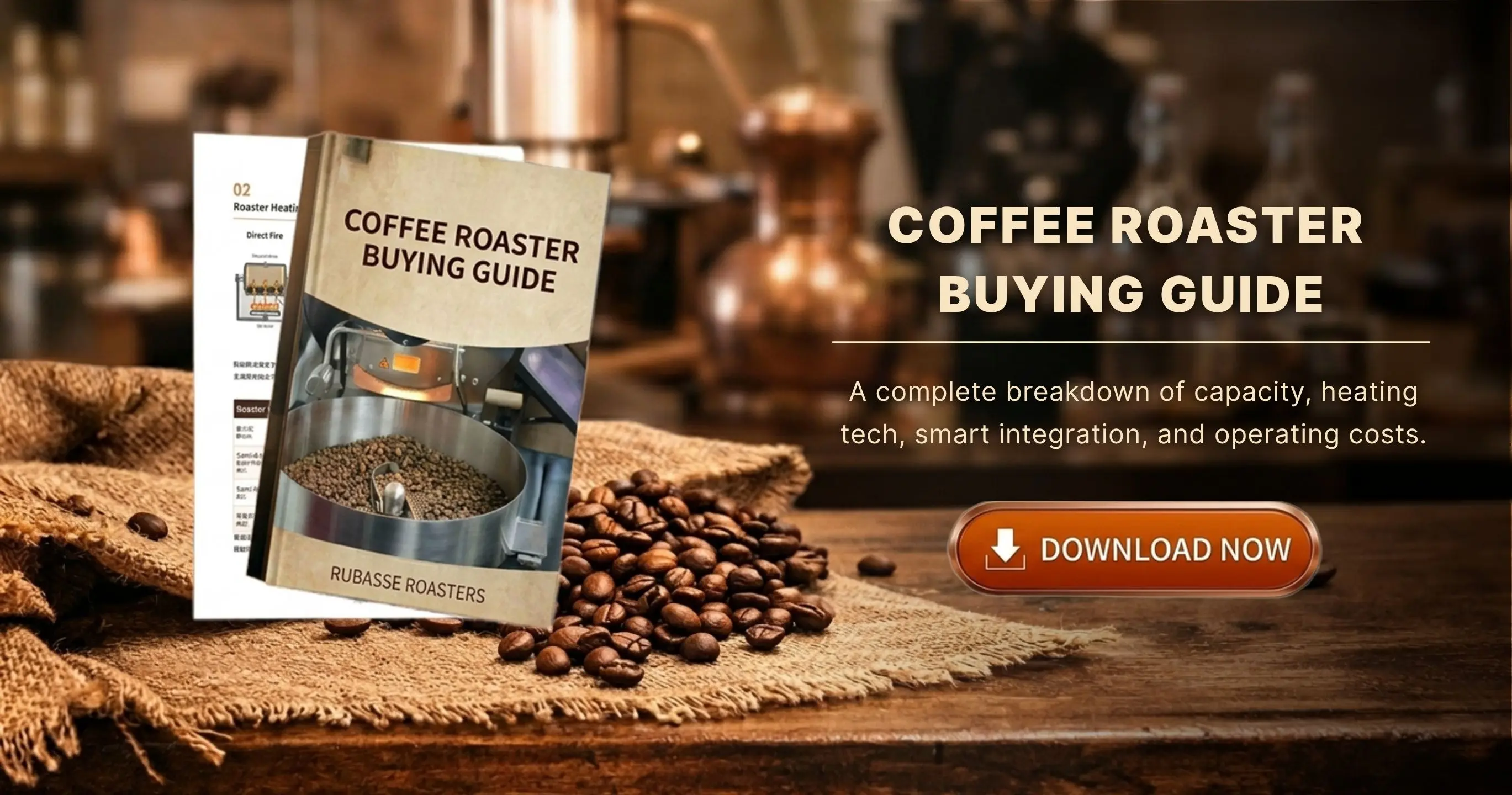
Specialty coffee roasting is entering an era of intelligence. This professional guide is designed to help you avoid costly investment pitfalls. Gain insights into the latest roasting technologies and capacity architectures to master balancing flavor consistency with production efficiency in a diverse specialty coffee market.
If your roasting facility is facing the following challenges, this guide is essential:
- Capacity Bottlenecks: Using a single large machine leads to frequent bean changes and decreased efficiency.
- Reliance on Experience: Roast quality depends heavily on the intuition of senior roasters, making stability hard to maintain.
- Operational Pressures: Rising energy costs and exhaust regulations are becoming significant burdens.
These issues often arise not from a lack of skill, but because your equipment architecture can no longer support the “small batches, many varieties” nature of specialty coffee. Recently, professional roasteries have shifted from “standalone units” to “roasting systems” using Parallel Production. This allows different beans to be roasted simultaneously, slashing changeover times and maximizing utilization. Furthermore, roasting has evolved from sensory-based craft to data-driven profile control, ensuring every batch can be stably reproduced.
The “Commercial Coffee Roaster Buying Guide” compiles the latest technology and investment strategies to help you make precise decisions. The guide includes:
- Capacity Planning & Investment Logic: Distinguish between home and commercial needs to accurately assess your scale and avoid the high cost of insufficient capacity.
- Roaster Heating Types: Compare the heating characteristics and flavor profiles of Direct Flame, Semi-Hot Air, Hot Air, and Fluid Bed systems.
- Evolution of Heat Sources: A deep dive into Gas, Electric, and Near-Infrared (NIR), exploring how NIR technology overcomes traditional thermal inertia to provide fast, penetrating heating.
- Airflow & Pressure Control: Learn why digital airflow and pressure differential sensors are standard for professional-grade machines to ensure uniformity.
- Drum & Agitation Design: Understand the engineering balance between heat retention, conduction, and uniformity, and how it affects batch stability.
- Capacity Liberation through Automation: Discover how full-process automation reduces the cognitive load on roasters and boosts output.
- Software Integration: Data-driven roasting aesthetics—achieving visualization and precise control over six core metrics.
- Profile Reproduction (Auto-Replicating): Explore the different levels of automation—Command, Bean Temp, and RoR (Rate of Rise) Reproduction—and their impact on consistency.
- Comparison of Smoke Removal Equipment: Analyze the efficiency and costs of ESP (Electrostatic Precipitator) , Wet Scrubbers, Activated Carbon, and Afterburners to stay compliant with urban regulations.
- Environmental Comfort & Energy Efficiency: Roaster selection in the ESG era. Learn how breakthrough technologies like NIR can reduce energy consumption by up to 80% while maintaining a comfortable 25°C workspace.
If you are evaluating your next equipment investment, this guide will clarify technical differences and strategic options. Fill out the information below to download the full version of the “Commercial Coffee Roaster Buying Guide.” Master the 10 key assessment metrics and avoid costly decision errors today.
From capacity planning and heating principles to software integration and operating costs — A comprehensive breakdown of the buying logic for commercial coffee roasters
| 01 | Capacity Planning & Investment Logic: Home vs. Commercial |
The first step in choosing a coffee roaster is not comparing specifications, but clarifying your capacity requirements and business model. A machine’s drum capacity directly determines your monthly output ceiling, roasting rhythm, and staffing, which in turn determines the feasibility of your overall return on investment.
Home or micro roasting (≤500 g) is suitable for hobbyists and small-scale training scenarios with low investment thresholds but obvious capacity ceilings. Mid-size commercial machines (1–5 kg) serve as the primary range for specialty coffee shops and small-scale contract roasting. Large commercial machines (10 kg+) target factory-level mass production and stable channel supply.
| Category | Drum Capacity | Est. Monthly Output | Application | Investment Level |
| Home / Micro | 100–500 g | < 50 kg | Personal use, training, sampling | < USD $3,000 |
| Small Commercial | 1–3 kg | 50–300 kg | Specialty shop in-house, small contract roasting | USD $3,000–$25,000 |
| Mid Commercial | 5–15 kg | 300–2,000 kg | Mid-size roastery, brand OEM | USD $25,000–$100,000 |
| Large Production | 20 kg+ | 2,000 kg+ | Factory production, OEM/ODM | USD $100,000+ |
◆ Parallel Production Mode: A Unique Capacity Strategy for Specialty Coffee
The core characteristic of specialty coffee is “small batches, many varieties.” A roastery may manage 15–30 single origins simultaneously, with each batch being only 3–10 kg. The traditional “single large machine” capacity mindset hits a bottleneck here: one machine can only roast one product at a time, and changeover time—switching beans, adjusting profiles, cleaning—significantly compresses effective output.
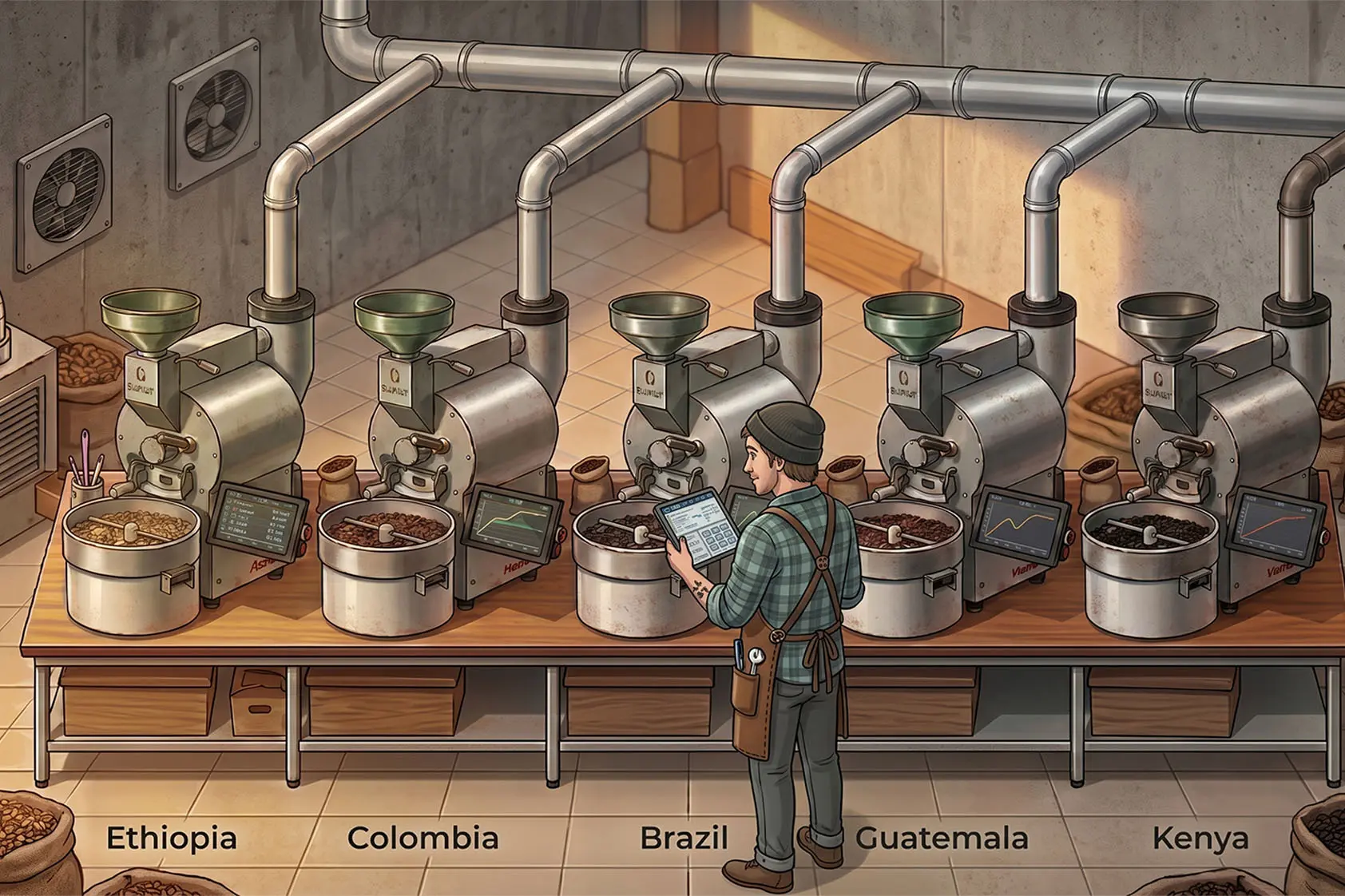
The “Parallel Production” model addresses this pain point by deploying multiple roasters (typically 2–4 units of the same or different sizes) so the roastery can produce different products simultaneously. Key advantages include:
• Shorter changeover cycles — Machine A roasts Ethiopian natural while Machine B simultaneously roasts Guatemalan washed, eliminating single-machine idle time.
• Higher daily utilization — Multiple machines rotate, fully utilizing inter-batch gaps (cooling, reheating), increasing daily output by 50–80%.
• Reduced cross-contamination risk — Dedicated machines for specific roast levels or processes (e.g., one for light roast, one for medium-dark) prevent residual oils from affecting delicate light-roast flavor profiles.
• Flexible market response — When demand for a particular origin suddenly surges, all machines can be deployed on the same product to rapidly scale capacity.
Therefore, when evaluating capacity, you should not only look at “maximum single-drum capacity” but plan from the perspective of “total system capacity × number of concurrent products.” For specialty roasteries with more than 10 origins, a combination of “2–3 small-to-mid-size machines” often provides better operational flexibility and investment efficiency than “1 large machine.”
| 💡 Buying Tip z zPlan your drum size based on projected monthly output 2–3 years ahead, rather than price alone. Insufficient capacity leading to repeat purchases actually raises total cost of ownership. |
Whatsapp:https://chat.whatsapp.com/GkSBm0DEF3BDrbiozxJnRS