
5-minute version
Before You Buy a Commercial Roaster: 10 Questions to Ask
- How much will you roast per month, and how many origins?
- Direct flame, semi-hot air, hot air or fluid bed: which heating type fits your roast style?
- Gas, electric or near-infrared: which heat source can your site support?
- Can you control airflow precisely, and does the roaster measure drum pressure?
- Thick or thin drum? How evenly are the beans agitated?
- Which steps are automated: preheat, charge, roast, drop, cooling?
- What does the software record: bean temperature, RoR, airflow, heat power?
- Can it reproduce a profile by command, by bean temperature, or by RoR?
- What smoke and odor rules apply in your area, and which filter meets them?
- How much energy goes into the beans instead of heating air?
Tap any question to jump to that chapter.
Specialty coffee roasting is entering an era of intelligence. This professional guide is designed to help you avoid costly investment pitfalls. Gain insights into the latest roasting technologies and capacity architectures to master balancing flavor consistency with production efficiency in a diverse specialty coffee market.
If your roasting facility is facing the following challenges, this guide is essential:
- Capacity Bottlenecks: Using a single large machine leads to frequent bean changes and decreased efficiency.
- Reliance on Experience: Roast quality depends heavily on the intuition of senior roasters, making stability hard to maintain.
- Operational Pressures: Rising energy costs and exhaust regulations are becoming significant burdens.
These issues often arise not from a lack of skill, but because your equipment architecture can no longer support the “small batches, many varieties” nature of specialty coffee. Recently, professional roasteries have shifted from “standalone units” to “roasting systems” using Parallel Production. This allows different beans to be roasted simultaneously, slashing changeover times and maximizing utilization. Furthermore, roasting has evolved from sensory-based craft to data-driven profile control, ensuring every batch can be stably reproduced.
If you are evaluating your next equipment investment, this guide will clarify technical differences and strategic options. Master the 10 key assessment metrics and avoid costly decision errors today.
01 Capacity Planning & Investment Logic: Home vs. Commercial
The first step in choosing a coffee roaster is not comparing specifications, but clarifying your capacity requirements and business model. A machine’s drum capacity directly determines your monthly output ceiling, roasting rhythm, and staffing, which in turn determines the feasibility of your overall return on investment.
Home or micro roasting (≤500 g) is suitable for hobbyists and small-scale training scenarios with low investment thresholds but obvious capacity ceilings. Mid-size commercial machines (1–5 kg) serve as the primary range for specialty coffee shops and small-scale contract roasting. Large commercial machines (10 kg+) target factory-level mass production and stable channel supply.
| Category | Drum Capacity | Est. Monthly Output | Application | Investment Level |
| Home / Micro | 100–500 g | < 50 kg | Personal use, training, sampling | < $3,000 |
| Small Commercial | 1–3 kg | 50–300 kg | Specialty shop in-house, small contract roasting | $3,000–$25,000 |
| Mid Commercial | 5–15 kg | 300–2,000 kg | Mid-size roastery, brand OEM | $25,000–$100,000 |
| Large Production | 20 kg+ | 2,000 kg+ | Factory production, OEM/ODM | $100,000+ |
◆ Parallel Production Mode: A Unique Capacity Strategy for Specialty Coffee
The core characteristic of specialty coffee is “small batches, many varieties.” A roastery may manage 15–30 single origins simultaneously, with each batch being only 3–10 kg. The traditional “single large machine” capacity mindset hits a bottleneck here: one machine can only roast one product at a time, and changeover time—switching beans, adjusting profiles, cleaning—significantly compresses effective output.
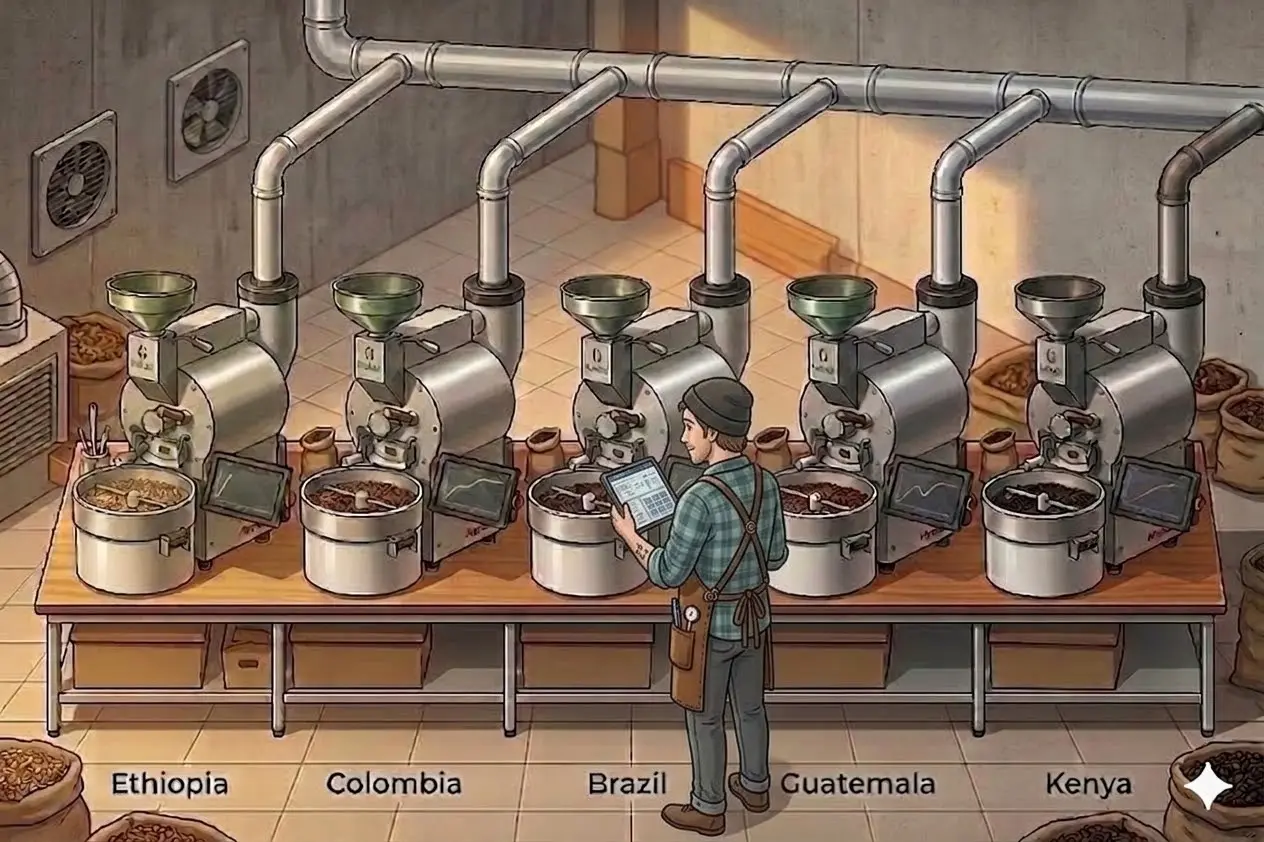
The “Parallel Production” model addresses this pain point by deploying multiple roasters (typically 2–4 units of the same or different sizes) so the roastery can produce different products simultaneously. Key advantages include:
• Shorter changeover cycles — Machine A roasts Ethiopian natural while Machine B simultaneously roasts Guatemalan washed, eliminating single-machine idle time.
• Higher daily utilization — Multiple machines rotate, fully utilizing inter-batch gaps (cooling, reheating), increasing daily output by 50–80%.
• Reduced cross-contamination risk — Dedicated machines for specific roast levels or processes (e.g., one for light roast, one for medium-dark) prevent residual oils from affecting delicate light-roast flavor profiles.
• Flexible market response — When demand for a particular origin suddenly surges, all machines can be deployed on the same product to rapidly scale capacity.
Therefore, when evaluating capacity, you should not only look at “maximum single-drum capacity” but plan from the perspective of “total system capacity × number of concurrent products.” For specialty roasteries with more than 10 origins, a combination of “2–3 small-to-mid-size machines” often provides better operational flexibility and investment efficiency than “1 large machine.”
| 💡 Buying TipPlan your drum size based on projected monthly output 2–3 years ahead, rather than price alone. Insufficient capacity leading to repeat purchases actually raises total cost of ownership. |
Not sure which drum size matches your projected monthly output? Ask our engineers →
02 Roaster Heating Types:Direct Flame, Semi-Hot Air, Hot Air, Fluid Bed
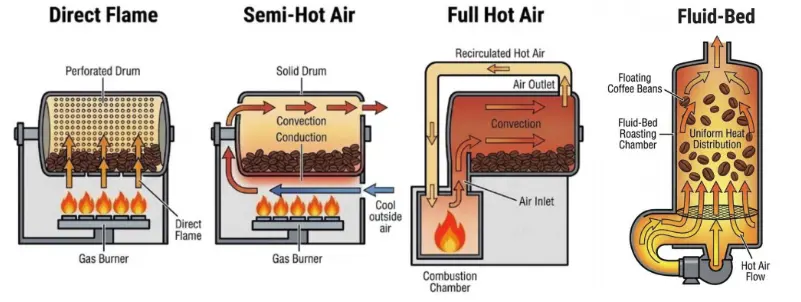
The heating type determines how thermal energy is delivered to the coffee beans, directly affecting flavor profile, roasting efficiency, and control flexibility. The current market mainstream can be divided into four major categories:
| Type | Heat Transfer Principle | Flavor Characteristics | Control Difficulty | Representative Machines | Target Users |
| Direct Flame (Drum) | Drum contact conduction + radiation; flame directly heats the drum | Bold aroma, pronounced caramel sweetness | High | Fuji-Royal | Roasters pursuing bright aromatic profiles |
| Semi-Hot Air | Air heated by flame enters the drum; flame also contacts drum wall; improved direct-flame design | High body, full mouthfeel, rich sweetness | Medium-High | Probat, Giesen, Diedrich | Roasters pursuing thick, full-bodied flavor |
| Hot Air | Convection-dominant; heated airflow directly envelops the beans | Clean, bright, floral/fruity notes, crisp finish | Medium | Loring, IMF | Those preferring light-to-medium bright profiles |
| Fluid Bed | Strong convection suspends beans in airflow for uniform heating | Clean, even | Medium | IKAWA, Link | Small sample roasting scenarios |
| 💡 Trend WatchNotably, many modern machines are no longer a single type but hybrid designs—for example, using a drum as the structural foundation while incorporating high-volume hot air supply, balancing the body with cleanliness. When purchasing, you should conduct actual test roasts rather than relying solely on type classification. |
03 Heat Source Evolution: Gas, Electric, and Near-Infrared
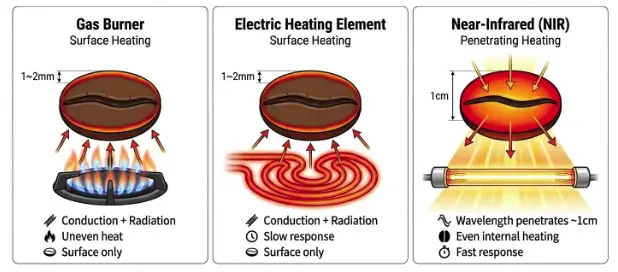
The heat source is the roaster’s “energy engine,” affecting not only roast curve controllability but also installation requirements, regulatory thresholds, and long-term operating costs.
| Heat Source | Ramp-up Speed | Temperature Precision | Notes |
| Gas | Fast | Low (depends on proportional valve quality) | High heat output and ample thermal energy, but temperature control is difficult; precision limited by mechanical proportional valve adjustment |
| Electric | Slow | High (controlling current and wattage) | Slow response and high power consumption, but no open flame; high safety; suitable for urban spaces |
| Near-Infrared (NIR) | Very Fast | High (controlling current and wattage) | High heat output, fast response, and safe; combines the ample thermal energy of gas with the precision and safety of electric |
◆ Near-Infrared (NIR) vs. Far-Infrared (FIR): Why NIR Is the Better Electric Solution
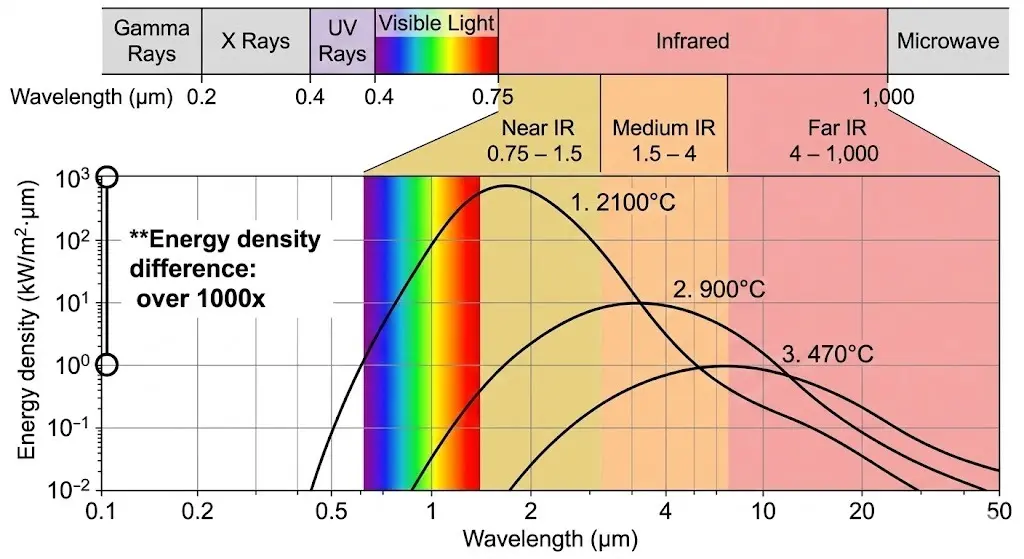
When it comes to electric roasters, many people are unaware that the vast majority of electric machines on the market actually use far-infrared (FIR)—the thermal radiation emitted by heating elements and coils, with wavelengths in the 3–1,000 μm range. FIR’s physical properties mean it can only act on an extremely shallow layer of the bean surface (approximately 0.1 mm or less), and heat must penetrate the bean interior through slow conduction. Additionally, FIR has low energy density spread across a broad spectrum, causing significant heat loss to the surrounding air and drum walls, with only a limited proportion reaching the coffee beans. This is why traditional electric machines generally have high power consumption and low energy efficiency.
Near-infrared (NIR) is fundamentally different. NIR wavelengths are only 0.75–3 μm, in the short-wave range, with two key physical advantages. First, strong penetration—NIR short-wave photons can pass through the bean surface to deliver energy directly to the bean interior, achieving uniform inside-out heating without relying on slow surface conduction. Second, high energy density—NIR energy is concentrated in a narrow band, with heat flux per unit area far exceeding FIR, delivering stronger heating effects with less power.
The practical significance for coffee roasting is: NIR achieves equal or better heating with lower power consumption, more uniform bean heating, faster temperature response, and higher temperature control precision. For specialty roasters, NIR is currently the more ideal electric heating solution.
| 💡 Trend WatchAs environmental regulations tighten and urban mixed-use spaces impose restrictions, demand for electrically powered roasters is steadily rising. Near-infrared (NIR) technology, with its extremely fast response and penetrating heating characteristics, is beginning to enter the specialty roasting field and deserves ongoing attention. |
04 Airflow & Pressure Differential Control:Core Standards for Professional Machines
For experienced roasters, airflow control is often more critical than heat adjustment. Specialty roasting demands precision control—roasters need to adjust airflow in real time based on different bean varieties’ moisture content, density, and roast stage to precisely guide Maillard reaction development speed, chaff removal efficiency, and final flavor cleanliness. Therefore, a roaster’s airflow control capability is one of the core indicators of its professional grade.
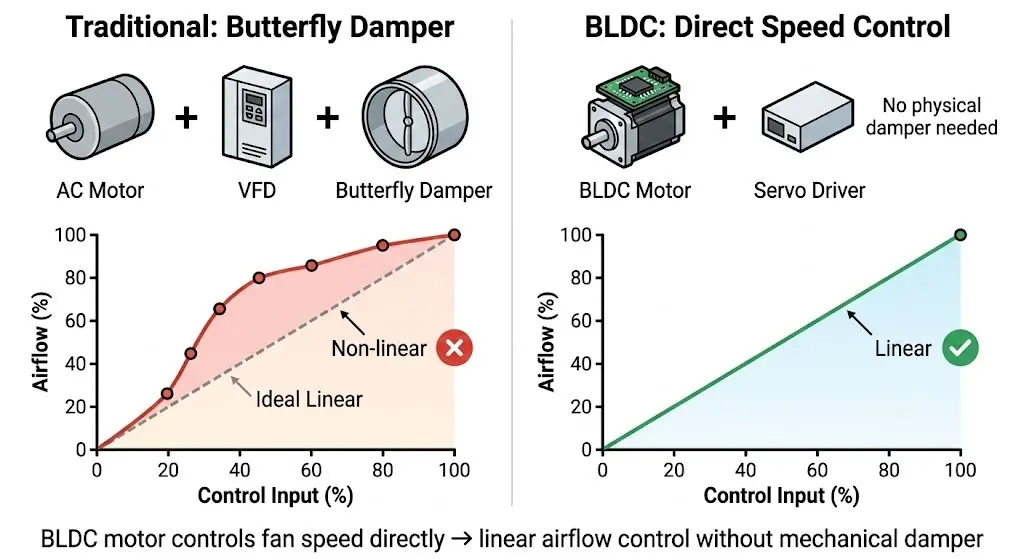
| Comparison | Traditional Damper (Manual Baffle) | Variable Frequency Fan (Inverter Fan) |
| Adjustment Method | Manual baffle opening area adjustment | Fan motor speed control (RPM) |
| Precision | Low (estimated by markings or feel) | High (precise values, linear control) |
| Data Feedback | Cannot quantify actual opening | Speed can be read and logged in real time |
| Recipe Recordability | Difficult to precisely record and reproduce | Speed parameters can be written into recipes; highly repeatable |
| Automation Integration | Does not support programmatic control | Can integrate with automated profile following |
| Application | Entry-level machines, cost-sensitive scenarios | Mid-to-high-end commercial, specialty roasting |
Beyond dampers or fans, there are two advanced airflow control dimensions worth noting:
◆ Pressure Differential Sensor
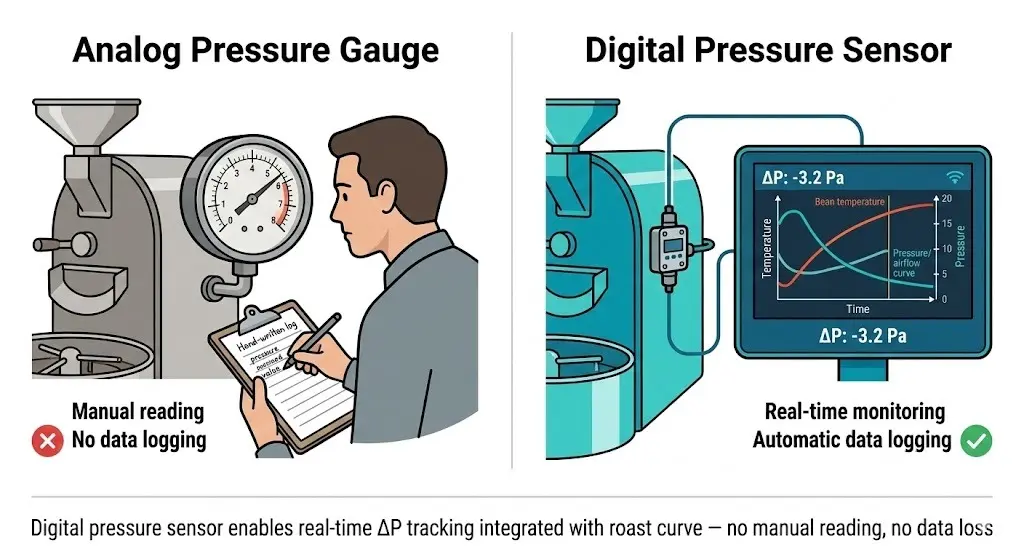
Pressure differential represents the pressure difference between the inside and outside of the drum (unit: Pa), and is the actual measurement of how airflow ultimately affects the drum environment. This concept can be understood by analogy: just as heat intensity affects the rate of rise (RoR), airflow intensity affects pressure differential. Whether you use a manual damper or variable frequency fan to adjust airflow, the physical result reflected inside the drum is the change in pressure differential value.
Professional roasters are equipped with pressure differential sensors that display positive/negative pressure values in real time, enabling roasters to establish quantifiable, reproducible pressure differential curves. With pressure differential data, roasting recipes include not just temperature and time, but a complete airflow dimension, significantly improving batch-to-batch consistency.
◆ Advanced Feature: Pressure Compensation System
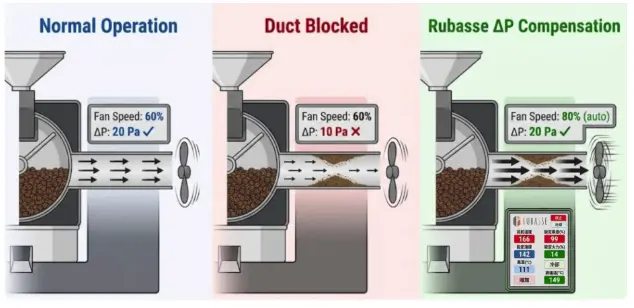
The pressure compensation system is an important advanced feature on high-end roasters in recent years. Its operating logic is: paired with a pressure differential sensor to record pressure differential values at each time point in the roasting curve, it then uses PID control algorithms to automatically adjust fan speed, compensating for pressure differential deviations in real time to reproduce the pressure environment from the original recipe.
Why is this important? Because roasting conditions are not constant—outdoor wind speed, exhaust duct resistance, chaff accumulation, and even the exhaust state of adjacent machines all affect the actual pressure differential inside the drum. Even with identical fan speed settings, pressure differentials at different times can be vastly different. The core value of the pressure compensation system is: ensuring a stable airflow environment inside the drum, not merely stable fan speed. Only when environmental conditions are stable can roast flavor truly be stable.
| 💡 Buying TipThe completeness of airflow control can serve as an indicator of a roaster’s professional grade: manual damper is basic, variable frequency fan is standard, pressure differential sensor is advanced, and pressure compensation system is top-tier. We recommend at minimum selecting a machine with a variable frequency fan + pressure differential sensor to leave room for future recipe refinement and automation. |
Want us to check the airflow spec of the roaster you are considering? Ask our engineers →
05 Drum & Agitation Design:The Engineering Balance of Heat Retention, Conduction, and Uniformity
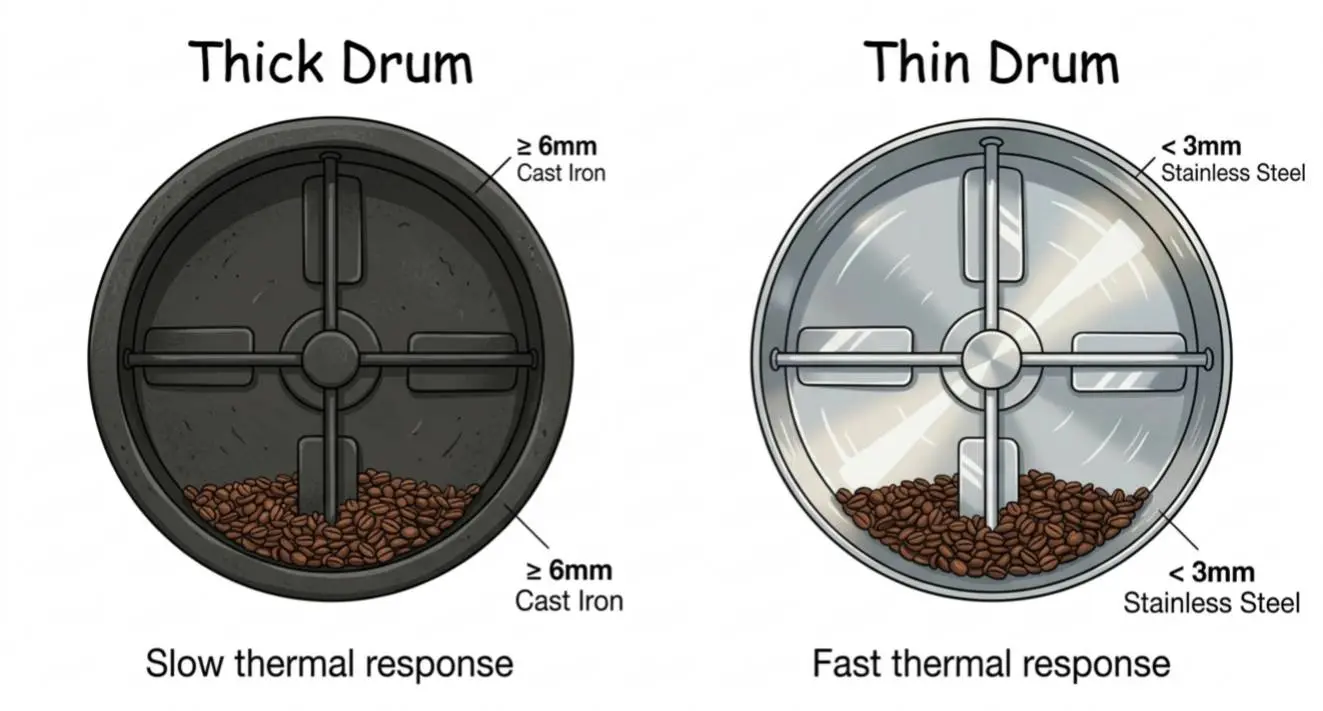
The drum is the heart of a coffee roaster, and its wall thickness, material, and agitation design are interconnected, collectively determining a machine’s heat retention characteristics, heat transfer efficiency, and flavor profile. More importantly, these choices are not independent decisions—they are directly linked to your chosen heat source type.
For gas machines, since gas flame heat is concentrated and intense, thin drum walls conduct heat too quickly, and the drum body is prone to deformation over prolonged exposure. Cast iron, which has excellent heat retention and relatively low cost, naturally serves as a “thermal buffer,” making the heating rhythm more stable and controllable—this is why gas + cast iron thick drum is the industry’s most classic combination.
Conversely, for electric machines, since heating elements have slow response, pairing with thin drums can partially compensate—thin walls conduct heat faster, delivering thermal energy to the beans more quickly. Meanwhile, electric heating elements don’t concentrate heat as intensely as gas, making the drum less prone to localized overheating deformation, so thin drums are viable for electric machines. Thin walls made of stainless steel keep costs reasonable without the rust issues of cast iron—this is why electric + stainless steel thin drum is another common configuration.
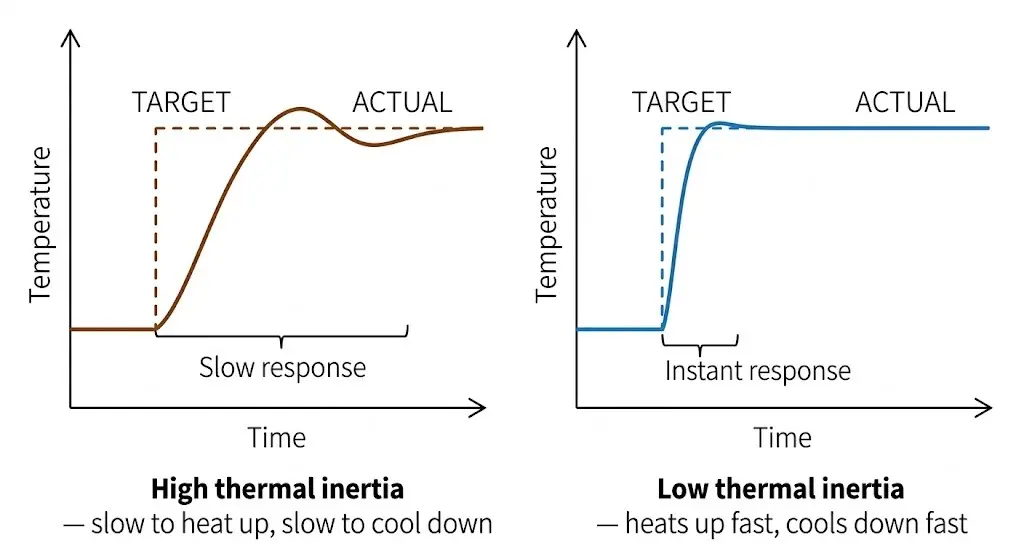
| Comparison | Thick Drum (Cast Iron / Carbon Steel) | Thin Drum (Stainless Steel) |
| Typical Wall Thickness | 6 mm or more | Less than 3 mm |
| Heat Retention | High; small charge temp drop, fast recovery | Low; larger charge temp drop |
| Temperature Response | Slow; delayed reaction after heat adjustment | Fast; heat changes reflected immediately |
| Thermal Inertia | Large (acts as thermal buffer) | Small (strong precision-following capability) |
| Matching Heat Source | Gas (thick drum compensates gas response delay) | Electric / NIR (leverages fast response advantage) |
| Common Materials | Cast iron (excellent heat retention, suitable for thick-wall casting); Carbon steel (balance of retention and workability) | Stainless steel (corrosion resistant, moderate conductivity, suitable for thin-wall precision structures) |
| Control Characteristics | Suited for steady-rhythm medium-dark roast development; not suited for frequent micro-adjustments | Suited for flexible roasting styles; heat adjustments reflected immediately |
| Durability | Cast iron: extremely durable but needs rust prevention; Carbon steel: good | Excellent (oxidation-resistant, easy to clean) |
Beyond these two traditional configurations, there is a breakthrough approach: placing near-infrared (NIR) light sources at the drum center to directly heat coffee beans. Since infrared cannot penetrate metal drum walls, NIR energy is completely contained inside the drum, creating a blackbody radiation effect on the inner wall surface—effectively making the entire drum wall a secondary heat source. Combined with the fast response of stainless steel thin drums, this design simultaneously provides the abundant heat retention feel of thick drums (from continuous blackbody radiation heating) and the fast response advantage of thin drums—combining the strengths of both without their respective weaknesses.
◆ Agitation Design
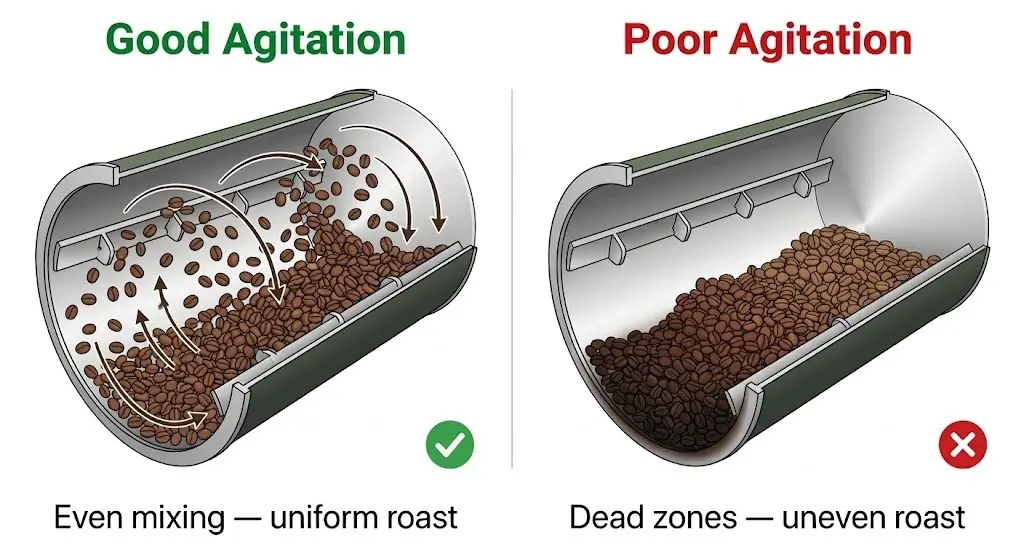
Good agitation design keeps every bean continuously changing position, preventing the same batch from remaining in a fixed heating zone. Since the heat source enters the drum at a fixed position, poor agitation causes some beans to overheat while others underdevelop. The most intuitive way to judge is through the sight glass: beans continuously tumbling evenly indicates good design; beans stalling in place indicates insufficient agitation efficiency.
◆ Drum Speed Adjustment
Fixed-speed machines require finding the optimal batch size and roasting frequently at that amount, because agitation efficiency changes when the charge weight changes. Machines with variable speed capability can adjust to the optimal speed based on charge weight, greatly improving operational flexibility.
| 💡 Buying TipDrum thickness, material, and heat source are an interconnected set of decisions. When purchasing, confirm whether the drum supports speed adjustment, and personally inspect agitation performance through the sight glass. |
06 Capacity Liberation Through Automation
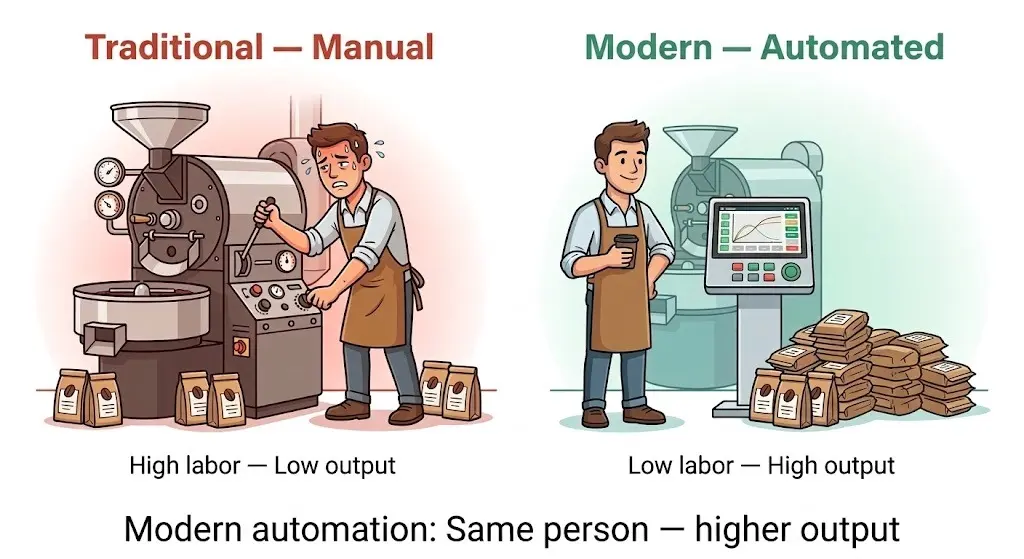
Roasting is highly repetitive physical and attention-intensive work. When daily output exceeds a certain threshold, automation transitions from a “nice-to-have” to a “survival necessity.” The true value of automation lies not just in saving labor, but in linking the complete roasting workflow into a seamless automated process, freeing roasters’ cognitive bandwidth so they can focus on quality judgment rather than mechanical operations.
◆ Complete Process Automation Workflow
An ideal automation system covers every step from green beans entering the hopper to cooled beans ready for packaging:
• Auto Preheat — The roaster sets the target preheat temperature, and the machine automatically ignites (or activates the electric heater) and maintains a constant temperature until the roaster is ready to charge. This seemingly simple feature saves 20–40 minutes of manual furnace monitoring before each work day, freeing the roaster to prepare green beans, inspect equipment, or plan the day’s schedule during preheat.
• Auto Feed to Charge Hopper — Green beans from storage bins or bulk packaging are automatically transferred to the roaster’s charge hopper via conveying systems (screw conveyor, pneumatic suction, etc.), with weighing sensors precisely controlling each batch’s charge weight, eliminating manual weighing errors.
• Auto Charge — When the drum reaches the preset charge temperature, the charge gate automatically opens, green beans enter the drum, and the timer simultaneously resets and starts. No more manually watching temperatures waiting to charge.
• Auto Roast — Heat, airflow, and drum speed automatically adjust according to the pre-stored roast profile, with the system correcting deviations in real time to ensure curve-following precision.
• Auto Drop — Upon reaching the target temperature, development time, or preset RoR conditions, the drop gate automatically opens and beans fall into the cooling tray. This locks in the optimal drop timing, preventing over-development from human judgment delays.
• Auto Cooling — The cooling tray agitator arm and cooling fan automatically activate, rapidly reducing bean temperature to room temperature. After cooling, roasted beans are automatically discharged into the collection bin while the drum simultaneously reheats for the next batch.
The seamless connection of these five steps can compress “between-batch time” from the traditional 5–8 minutes to 2–3 minutes. Calculated over 8 working hours per day, daily capacity can increase by 20–35%. More importantly, roasters no longer need to rush between batches weighing beans, monitoring temperatures, and moving beans, and can instead focus on quality control and recipe optimization.
◆ Between Batch Protocol (BBP): The Key to Inter-Batch Readiness
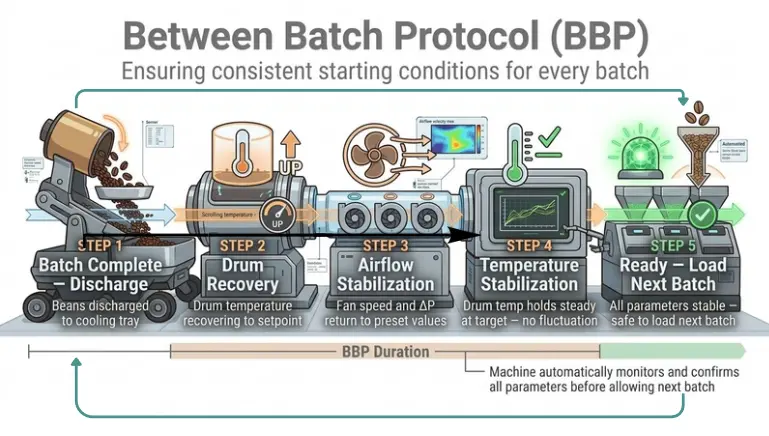
The most easily overlooked yet most impactful step on flavor consistency in the automation process is the readiness state between batches—known in the industry as Between Batch Protocol (BBP). BBP’s core concept is: before each batch begins, the drum must return to a “standardized ready state”—including drum temperature, drum wall heat storage, and internal airflow conditions should all be as consistent as possible. If inter-batch states are inconsistent, even using identical roast profiles will result in flavor drift between batches.
For example, before the first batch, the drum has been fully preheated and the drum walls are saturated with thermal energy. But if the second batch is charged immediately after the first batch is dropped, the drum may not have fully recovered—insufficient drum wall heat storage causes a delayed Turning Point after charge, a different ramping rhythm, and ultimately different flavor development.
Roasters with comprehensive BBP functionality automatically execute a standardized reheating procedure after dropping: automatically adjusting heat and airflow to return the drum to the preset charge temperature, maintaining constant temperature until the system determines the drum status meets criteria, then issuing a “ready to charge” signal. This ensures highly consistent starting conditions for every batch, forming the critical foundation for achieving batch-to-batch flavor stability.
Combined with the auto preheat function mentioned earlier, BBP forms a complete thermal management closed loop: auto preheat establishes the initial state at the start of the day, while BBP maintains consistent inter-batch conditions throughout the roasting session. Neither is complete without the other.
| 💡 Buying TipWhen evaluating automation level, don’t just look at single features like “does it have auto drop.” Instead, examine the completeness of the entire workflow linkage. Only when feeding, charging, roasting, dropping, and cooling are all automated and seamlessly connected can true capacity liberation be achieved. |
Want to know how many labour hours automation could actually save your team? Ask our engineers →
07 Software Integration: The Art of Data-Driven Roasting
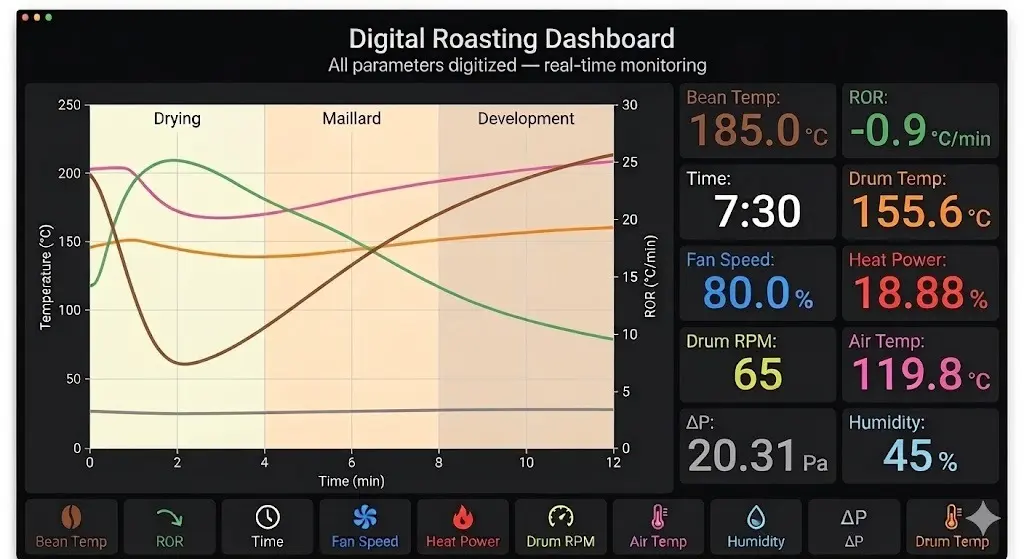
Modern specialty roasting has entered the data-driven era. To precisely control the roasting process and achieve stable flavor reproduction, roasters need to monitor a series of key data in real time. A good roasting software is not just a temperature curve recorder—it’s the core platform for recipe management, quality traceability, and team collaboration.
◆ Key Data During Roasting
The following data are the most fundamental and essential core metrics during roasting:
• Bean Temperature (BT) — Reflects the real-time temperature of the coffee bean itself; the most direct basis for judging roast progress and development stage.
• Rate of Rise (RoR) — The rate of change in bean temperature, reflecting the bean’s energy absorption state at each moment. RoR curve trends directly affect Maillard reaction and caramelization development rhythm.
• Time — Cumulative time from charge, combined with temperature data to construct the complete roast curve coordinates.
• Airflow — Fan speed or damper opening, reflecting the current airflow control state.
• Heat Power — Gas proportional valve opening or electric heat power percentage, reflecting the current thermal energy input.
• Drum Speed — Drum motor rotation speed (RPM), affecting bean agitation efficiency and heating uniformity.
These six items are foundational data that any commercial roaster should provide. Beyond these, some machines offer the following advanced data:
◆ Advanced Sensor Data
• Air Temperature — It is important to distinguish between “inlet air temp” and “exhaust air temp.” In semi-hot air or full hot air systems, inlet air temperature reflects the hot air entering the drum and is very helpful for understanding thermal input; exhaust air temperature reflects the airflow leaving the drum. For non-hot-air systems (pure direct flame), air temperature has relatively limited reference value.
• Pressure Differential — As discussed in Chapter 4, pressure differential reflects the pressure difference between inside and outside the drum and the actual exhaust conditions, serving as the most direct airflow control metric.
• Drum Temperature — Represents the drum wall surface temperature, reflecting the drum’s heat storage state. Particularly valuable for thick-drum machines during the BBP (between-batch preparation) phase.
• Humidity — More advanced roasters incorporate humidity sensors in the exhaust path, reflecting the actual moisture release during roasting in real time. Humidity data helps roasters more precisely determine the completion timing of the drying phase, especially critical for light roast quality control.
| 💡 Buying TipProfile Recording System — Profile recording systems are now an essential feature of modern commercial roasters. By recording bean temperature, RoR, heat power, airflow, pressure differential, and other data in real time and rendering them as visual curves, roasters can grasp all aspects of the roasting process at a glance from the interface. All roasting records can be completely stored for convenient post-review and recipe adjustments, and also support knowledge transfer between team members and standardized management. |
08 Profile Reproduction: Levels of Automation
For commercial roasting, stable flavor reproduction is the most core quality requirement. Whether for your own brand or contract roasting services, customers expect “every batch to taste the same.” Profile reproduction technology was born to solve this need, and different levels of reproduction have fundamental differences in precision and reliability.
◆ Level 1: Command Replication
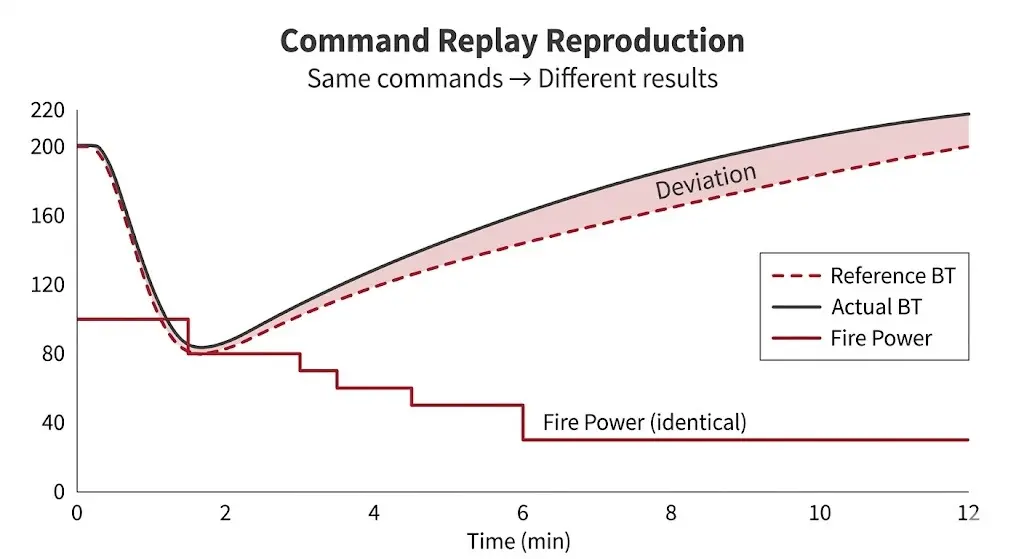
Command replication is the most basic automation level. The machine follows pre-recorded command sequences, adjusting heat, airflow, and drum speed to set values at specified time points or temperature points. For example: “At 2 minutes after charge, set heat to 60% and airflow to 40%” or “When bean temp reaches 160°C, reduce heat to 45% and open damper to 70%.”
This approach fundamentally “reproduces the operation” rather than “reproduces the result.” The machine faithfully executes every command but does not evaluate whether the actual bean temperature curve matches expectations. If environmental conditions change (room temperature, humidity, bean moisture content differ), identical commands may not produce identical temperature curves and flavor results. Command replication is suitable as an assistive tool to reduce manual operation burden, but still requires the roaster to monitor and manually intervene as needed.
◆ Level 2: Bean Temperature Replication
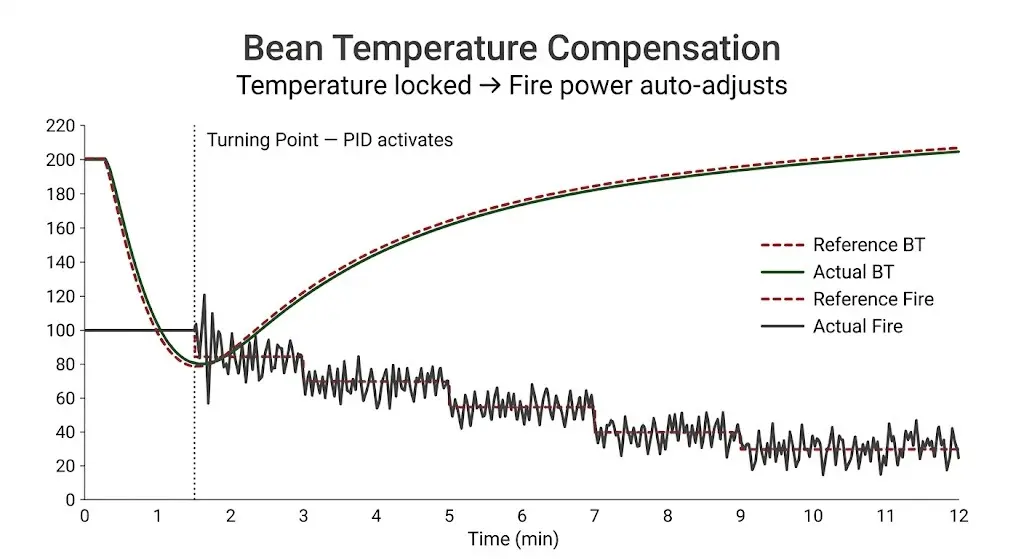
Bean temperature replication crosses the critical threshold from “reproducing the operation” to “reproducing the result.” The system no longer simply executes fixed commands on schedule. Instead, using the target bean temperature curve as a reference, it adjusts heat and airflow in real time via PID control algorithms to keep the actual bean temperature continuously aligned with the preset target curve.
When environmental conditions cause the bean temperature to deviate from the target—for example, lower room temperature in winter slowing the ramp—the system automatically increases heat to compensate; conversely, if ramping too fast, it automatically reduces heat. This “result-oriented” control approach significantly reduces the impact of environmental variables on flavor and is an essential foundation for achieving batch stability in commercial roasting.
◆ Level 3: RoR Replication
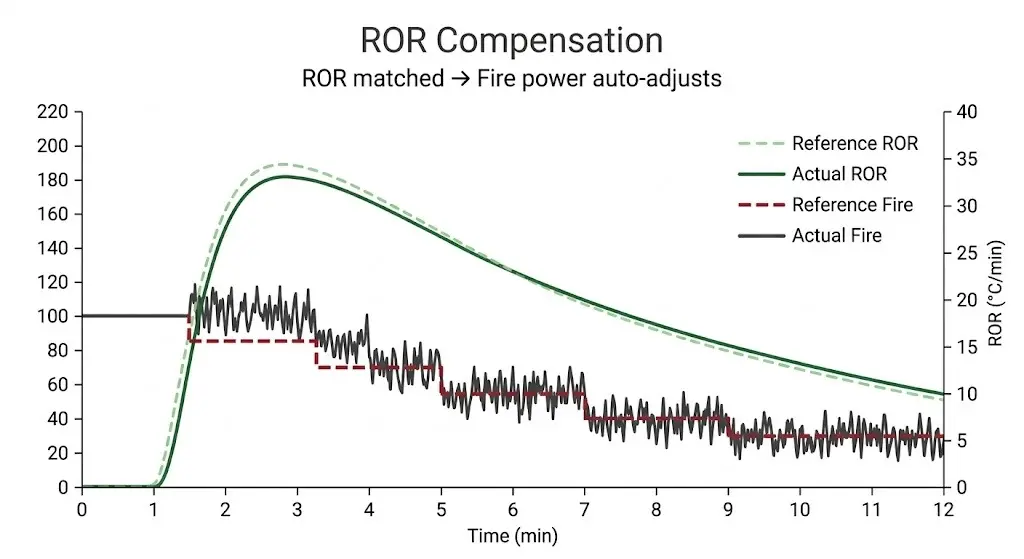
Building upon bean temperature replication, the most advanced systems further use Rate of Rise (RoR) as the control target. RoR reflects the bean’s energy absorption speed at each moment, describing the dynamic development of the roasting process more precisely than simple bean temperature values.
Why is RoR replication more advanced than bean temperature replication? Because even if two batches end at the same bean temperature, different ramping rhythms (RoR curves) in between mean different Maillard reaction and caramelization development paths, resulting in different flavors. Controlling RoR equals controlling the pace of chemical reaction progression—it is currently the highest-precision curve reproduction method. RoR replication demands more from computing power, sensor precision, and PID tuning, and is typically found on high-end commercial machines.
| Reproduction Level | Control Logic | Precision | Environmental Adaptability | Application |
| Command Replication | Executes pre-recorded heat/airflow/speed commands by time or temp point | Medium | Low (does not compensate for environmental changes) | Entry commercial, operation assist |
| Bean Temp Replication | PID real-time compensation to align actual BT with target curve | High | Medium-High (auto-compensates temp deviations) | Mid-to-high-end commercial |
| RoR Replication | Uses RoR as control target, precisely tracking ramping rhythm | Very High | High | High-end commercial, specialty contract roasting |
| 💡 Buying TipThe level of profile reproduction directly determines your quality ceiling. If your operation requires stable supply to multiple channels or contract roasting services, you should at minimum select a machine with bean temperature replication (PID compensation). RoR replication is a premium investment for those pursuing ultimate flavor stability. |
09 Smoke Removal Equipment:ESP, Wet Scrubber, Activated Carbon Filter, Afterburner
The roasting process generates large amounts of oily smoke, volatile organic compounds (VOCs), and fine particulates. In urban or mixed-use commercial/residential areas, smoke removal equipment is not optional—it is a prerequisite for legal operation. The four main types of smoke removal equipment on the market each target different pollutants with different treatment capabilities.
◆ Electrostatic Precipitator (ESP): Targeting Oily Smoke
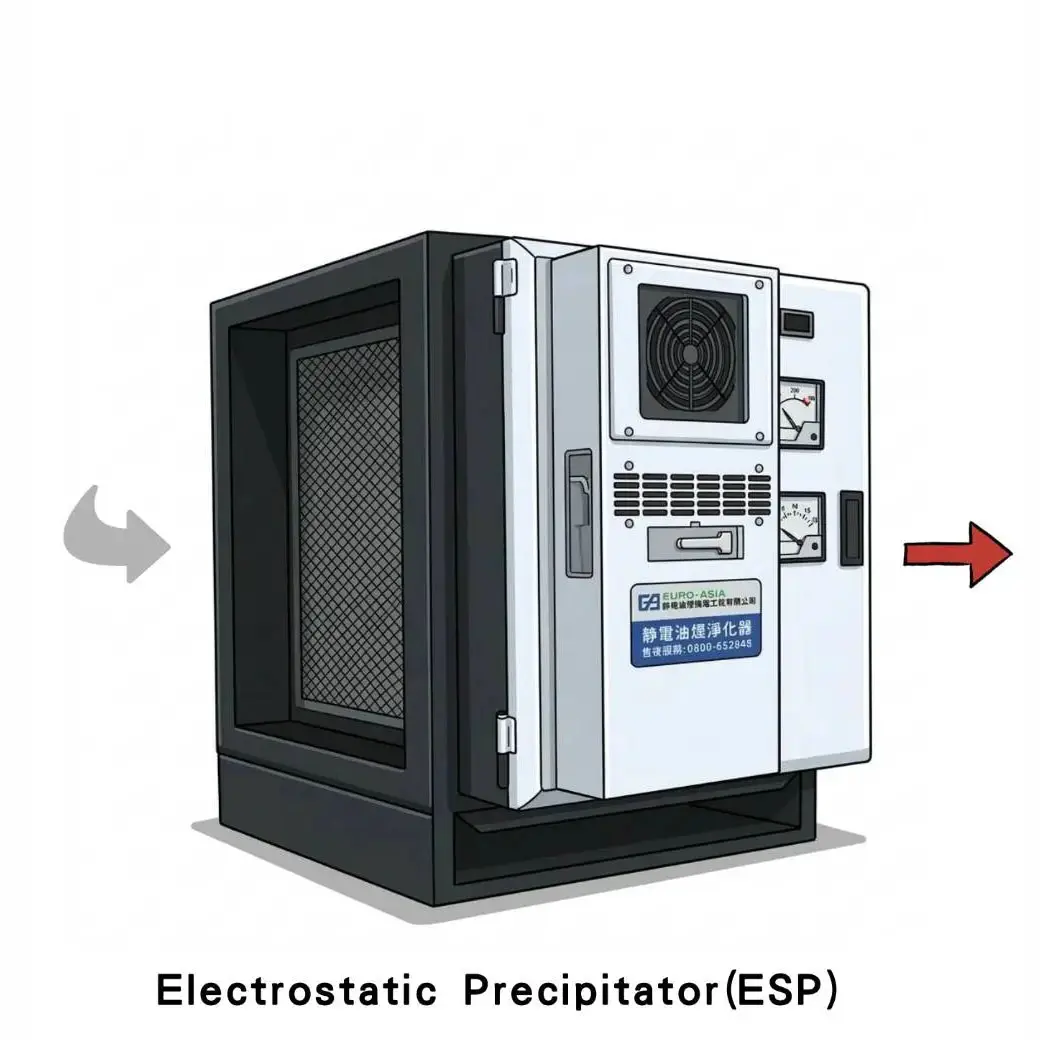
Electrostatic precipitators use high-voltage electric fields to charge particles in the smoke, then capture them on collection plates. Their core function is removing visible oily smoke particles, and they are very effective at reducing oily buildup in exhaust ducts and visible white smoke. However, ESPs have virtually no ability to treat gaseous odor molecules (VOCs), so using an ESP alone typically only solves the “visible” smoke while the “smellable” odor still escapes.
◆ Wet Scrubber: Targeting Odor
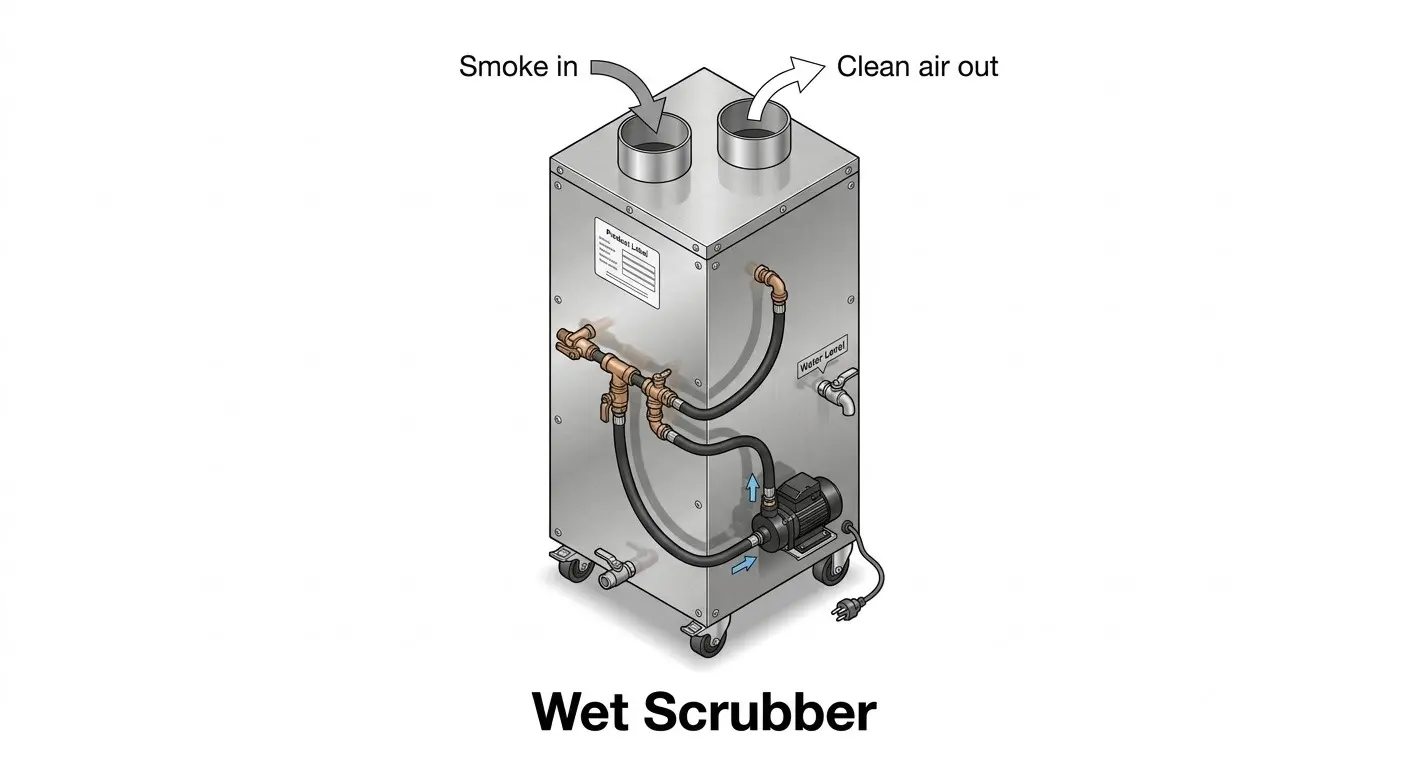
Wet scrubbers work by passing exhaust smoke through water mist or a water curtain, using water’s dissolving and adsorption capabilities to capture odor molecules and some particulates. Wet scrubbers are notably effective at removing caramel and smoky odors produced during roasting. Drawbacks include the need for continuous water supply and drainage, with wastewater requiring proper treatment; additionally, their interception rate for very fine oily smoke particles is less effective than ESPs.
◆ Activated Carbon Filter: Targeting Odor
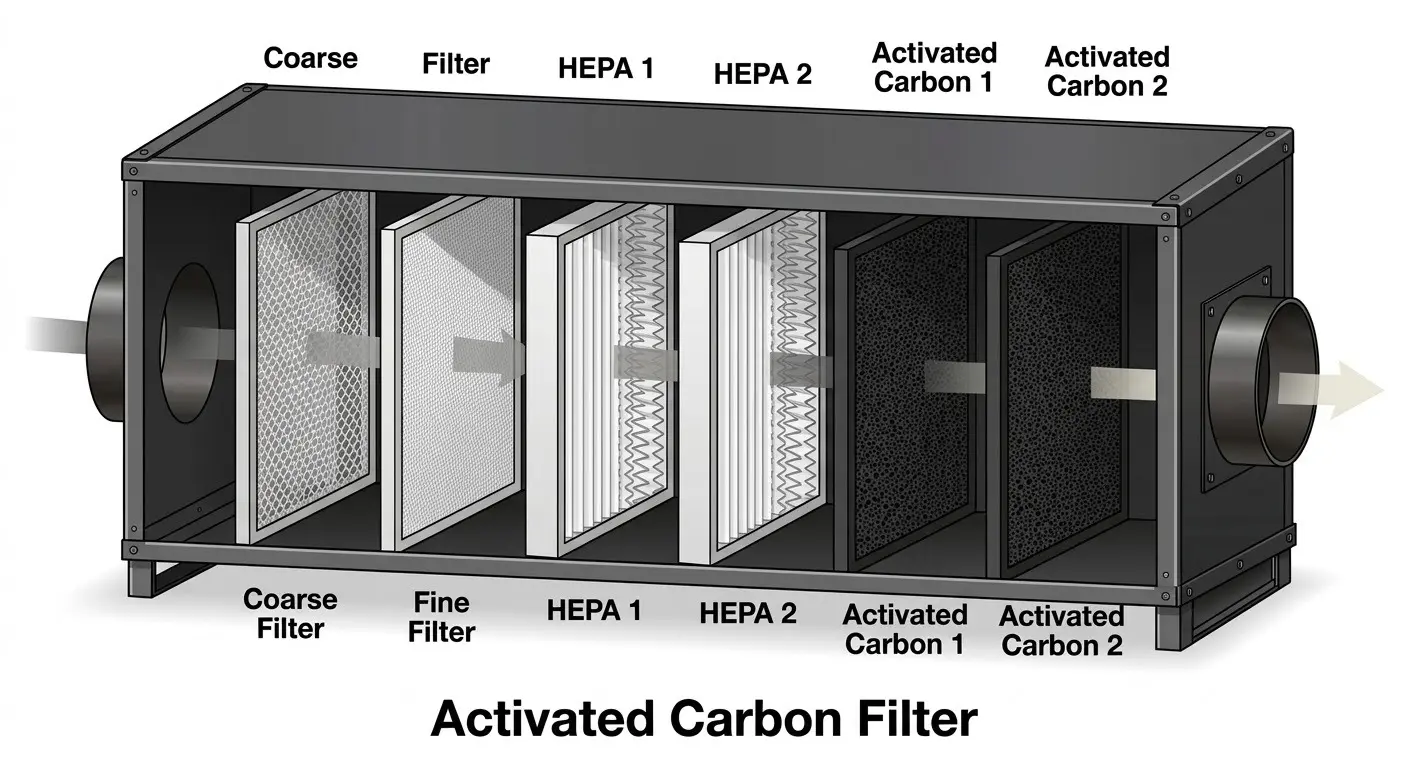
Activated carbon uses its massive microporous structure to capture gaseous odor molecules and VOCs through physical adsorption. Activated carbon filter boxes offer excellent deodorization effects with simple structures requiring no additional water or power setup. The main drawback is that activated carbon becomes saturated—adsorption capacity decreases over time, requiring periodic carbon material replacement, which is an ongoing consumable cost.
◆ Afterburner (Thermal Oxidizer): Solving Both Smoke and Odor
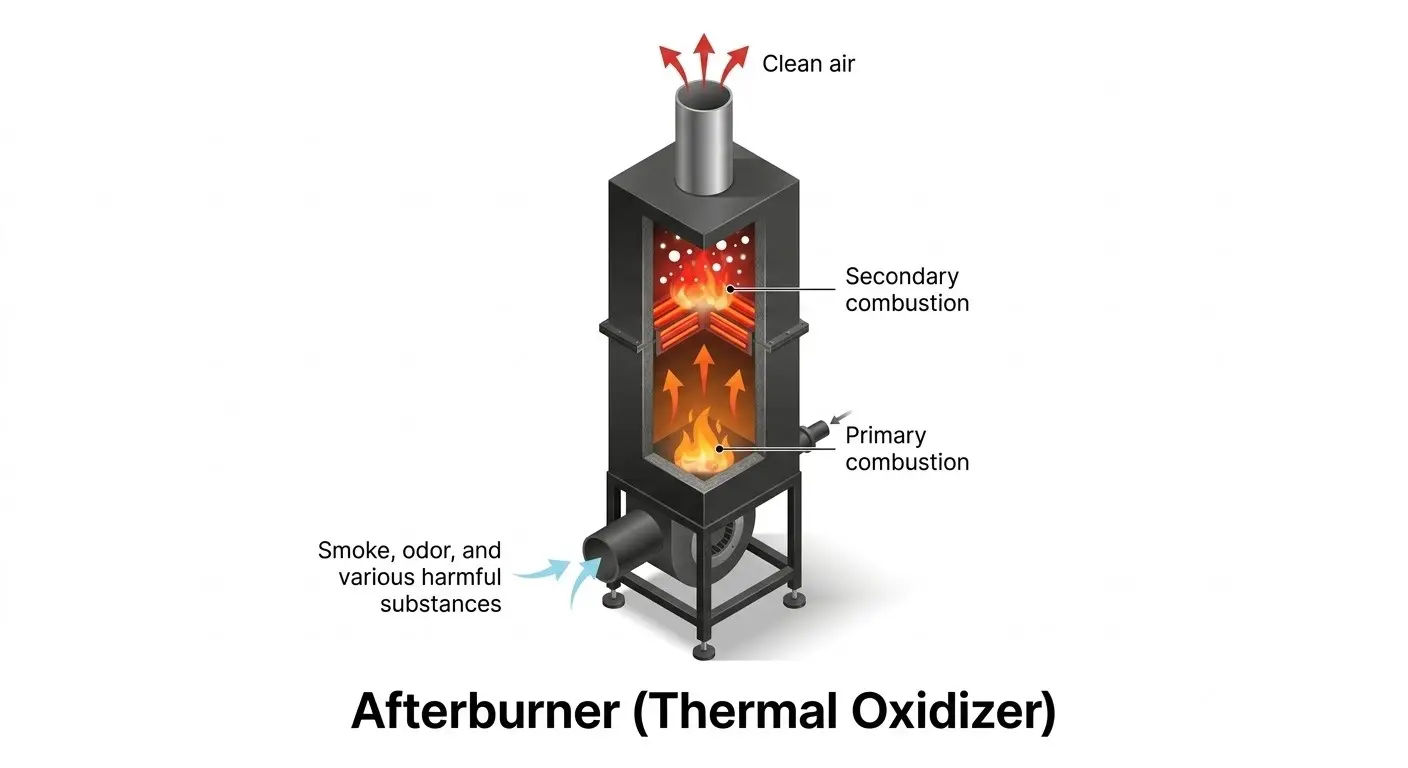
Afterburners use the most direct approach: routing exhaust smoke into a 600–800°C high-temperature combustion chamber, where high-temperature oxidation burns away both oily smoke particles and VOCs in one step. Afterburners have the highest smoke and odor removal efficiency of all four types, achieving virtually smokeless and odorless exhaust. Drawbacks are high purchase costs and continuous gas consumption during operation, making operating costs also the highest.
| Equipment Type | Smoke Removal | Odor Removal | Purchase Cost | Consumable Cost | Maintenance |
| Electrostatic Precipitator | High | Low | Medium | Low (mainly electricity) | Clean collection plates every 1–2 weeks |
| Wet Scrubber | Medium | Medium-High | Medium | Medium (water + wastewater treatment) | Regular tank cleaning, filter replacement |
| Activated Carbon Filter | Low | High | Low | Medium-High (periodic carbon replacement) | Periodic activated carbon replacement |
| Afterburner | Very High | Very High | High | High (high gas consumption) | Low (simple structure, few consumables) |
In practice, many commercial scenarios use combination solutions to balance cost and effectiveness. For example, “ESP + activated carbon” can address both smoke and odor within a limited budget, while “ESP + afterburner” is the top-tier configuration for achieving the highest emission standards. The choice depends on local regulatory requirements, site conditions, and budget.
| 💡 Regulatory ReminderSmoke emission standards for food service and food processing vary by jurisdiction. Be sure to confirm local environmental regulations before purchasing smoke removal equipment. Some regions have specific VOC emission limits, and an ESP alone may not meet compliance—deodorization equipment may be required for legal operation. |
Not sure how to meet the smoke emission rules in your area? Ask our engineers →
10 Environmental Comfort & Energy Efficiency:
Roaster Selection in the ESG Era
In today’s world where ESG (Environmental, Social, Governance) awareness is increasingly valued, a roaster’s energy efficiency and environmental friendliness are no longer just cost issues—they are part of brand image and sustainable business practice. How a roaster utilizes thermal energy directly determines whether your roasting environment is comfortable and reflects the machine’s respect for energy resources.
◆ The Energy Efficiency Dilemma of Traditional Heat Sources
The thermal energy utilization of most roasters currently on the market is still far from energy-efficient and environmentally friendly:
• Gas heat source — Combustion produces large amounts of water vapor and exhaust; a significant proportion of thermal energy exits with the exhaust rather than reaching the beans. The roasting space not only gets hotter but noticeably more humid, creating a stuffy, damp environment.
• Traditional electric heating elements (FIR) — Low energy efficiency ratio; consumes large amounts of electricity but primarily transfers heat through surface radiation, with only a limited proportion reaching the coffee beans. Heating elements are also consumables requiring periodic replacement.
• Electric wire heated-air hot air type — Requires continuously heating a large volume of airflow; the heated air passes through the drum and is immediately exhausted, carrying away significant thermal energy, resulting in very high power consumption.
The common problem with these traditional approaches is: most energy is consumed heating air, drum walls, or lost through exhaust, rather than acting directly on the coffee beans. Heat spillover not only wastes energy but also makes the roasting environment uncomfortably hot, which is inconsistent with ESG principles.
◆ Two Directions in Energy-Efficient Design
Currently, the roaster designs on the market with truly breakthrough energy efficiency advances follow two main directions:
Loring’s recirculating hot air system — Loring uses a unique closed-loop recirculating hot air design that recovers and reuses high-temperature exhaust gases, dramatically reducing heat waste. This design keeps hot air circulating within the system rather than being directly exhausted, significantly improving energy utilization while reducing emissions.
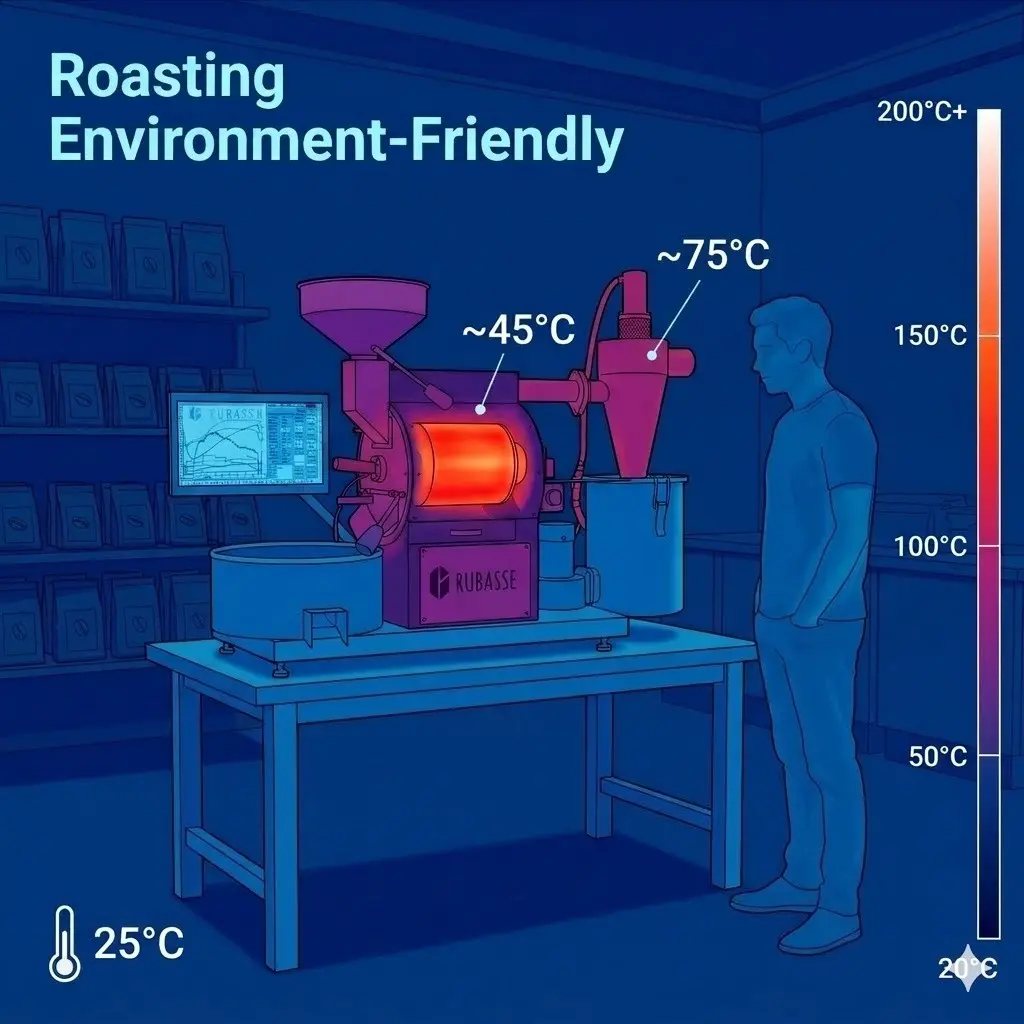
Rubasse’s near-infrared (NIR) center heating — Rubasse uses NIR penetrating heating technology to precisely deliver thermal energy into the drum interior and onto the coffee beans, unlike traditional heat sources that first heat drum walls or large volumes of air for indirect transfer. Since energy acts directly on the target, very little heat escapes the machine body, allowing roasters to work in comfortable ambient temperatures. Rubasse uses only 5,000W of power to roast 3 kg of coffee beans, while traditional electric machines of similar capacity typically require 30,000–40,000W. This not only dramatically reduces electricity costs but also lowers the facility’s electrical capacity requirements.
| 💡 Buying TipEnergy efficiency affects not just your monthly electricity bill—it reflects a roaster’s engineering design quality and the brand’s attitude toward sustainability. For the same capacity, choosing a more energy-efficient machine is both responsible for your operating costs and responsible for the environment. |
Choosing the Right Roaster Is the Most Important Infrastructure for Your Specialty Coffee Business
The 10 key factors above help you comprehensively evaluate a roaster’s true capabilities—from capacity and heating to airflow and automation.
Rubasse uses near-infrared (NIR) penetrating heating as its core technology, combined with a pressure compensation system, variable frequency fans, process automation, and OEM profile recording software, to create a new-generation roaster that is highly energy-efficient, highly precise, and environmentally friendly. From capacity planning to profile reproduction, every key factor mentioned in this article is a direction that the Rubasse design team continues to advance.
If you are evaluating coffee roasters or are interested in how NIR technology can enhance your roasting quality and operational efficiency, we invite you to fill out the form below with your contact information and requirements. Our professional team will reach out after receiving your submission to provide personalized consultation based on your capacity needs, site conditions, and roasting style.
Roasters using Rubasse







Get the PDF Guide + Expert Advice
Leave your details and the full PDF guide opens right away.
Tell us your monthly output in the last box — our team will recommend the right roaster size.
Glossary: Technical Terminology (tap to expand)
Coffee Roaster|烘豆機
A machine that transforms green coffee beans into roasted beans through controlled application of heat over time, triggering Maillard, caramelization, and other thermochemical reactions that develop flavor.
Capacity Planning|產能定位
The process of matching roaster size and configuration to projected monthly output, business model, and growth trajectory. Typically the first step in any roaster purchase decision.
Drum Capacity|鍋爐容量
The maximum batch size a roaster can process per cycle, usually expressed in kilograms (e.g., 1 kg, 5 kg, 30 kg). Determines monthly output ceiling and operational rhythm.
Estimated Monthly Output|月估產能
Projected total roasted coffee output per month, calculated from drum capacity × batches per day × operating days. Used to validate whether a roaster size meets business needs.
Parallel Production|平行量產
A capacity strategy using multiple roasters simultaneously to handle different origins or roast levels in parallel, increasing daily throughput and reducing changeover bottlenecks. Particularly suited for specialty roasters with many SKUs.
Small Batches, Many Varieties|少量多樣
The defining production pattern of specialty coffee — running many distinct origins and profiles in small per-batch quantities, in contrast to commodity roasting’s “single product, large volume” model.
Between-Batch Time|鍋間時間
The interval between dropping one batch and charging the next, including cooling, drum reheating, and preparation. Shortening this time directly increases daily output capacity.
Heating Type|加熱型式
The classification of how a roaster delivers thermal energy to the beans — typically direct flame, semi-hot air, full hot air, or fluid bed. Each type produces distinct flavor signatures.
Direct Flame (Drum Roaster)|直火式
A roaster design where the gas flame directly heats the rotating drum, with conduction and radiation as primary heat-transfer modes. Known for bold, expressive aromatics and pronounced caramel sweetness.
Semi-Hot Air|半熱風式
A hybrid design where heated air enters the drum while the flame still contacts the drum wall — a refined direct-flame variant. Produces full body, rich mouthfeel, and deep sweetness.
Hot Air (Full Hot Air)|熱風式
A roaster where heated airflow envelops the beans as the dominant heat-transfer mode, with little to no conductive contact. Yields clean, bright cup profiles with floral and fruity notes.
Fluid Bed|浮風式
A roaster design where powerful airflow suspends the beans within the heated stream, producing extremely uniform heating. Common in sample roasters and small-batch testing scenarios.
Heat Transfer Principle|傳熱原理
The physical mechanism by which thermal energy moves from heat source to coffee bean — conduction, convection, or radiation. Most roasters combine all three in varying proportions.
Convection|對流
Heat transfer via the movement of a fluid (typically heated air). The dominant mechanism in hot-air and fluid-bed roasters.
Conduction|傳導
Heat transfer through direct physical contact between materials, e.g., between the drum wall and the beans tumbling against it. Dominant in direct-flame drum roasters.
Radiation|輻射
Heat transfer via electromagnetic waves (infrared), without requiring physical contact or a transmitting medium. Critical in NIR-heated roasters.
Heat Source|熱源
The energy source driving the roaster — gas, electric heating elements, or near-infrared emitters. Choice affects ramp speed, control precision, safety, regulatory compliance, and operating cost.
Gas (Natural Gas / LPG)|瓦斯
A combustion-based heat source providing high heat output and rapid response. Temperature precision is limited by the mechanical proportional valve regulating gas flow.
Electric Heating|電熱
A heat source using resistive elements (or NIR emitters) to convert electricity into heat. Offers precise control and no open flame, but traditional resistive elements have slower thermal response than gas.
Near-Infrared (NIR)|近紅外線
Short-wavelength infrared radiation (0.75–3 μm) that penetrates the bean surface and delivers energy directly into the bean interior, enabling fast response, uniform heating, and high energy efficiency.
Far-Infrared (FIR)|遠紅外線
Long-wavelength infrared radiation (3–1,000 μm) that acts only on the bean surface; energy must conduct slowly inward. Lower energy efficiency than NIR; the technology behind most traditional electric roasters.
Proportional Valve|比例閥
A mechanical valve regulating gas flow to the burner. Its precision determines how finely a gas roaster can modulate heat output during the roast.
Penetrating Heating|穿透式加熱
A heating approach (typically NIR-based) where energy passes through the bean surface to heat the bean interior directly, producing more uniform development than surface-conduction methods.
Airflow Control|氣流控制
The roaster operator’s ability to modulate air movement through the drum, regulating heat-transfer rate, chaff removal, and flavor development. A core dimension of professional roast craft.
Damper (Baffle)|風門
A manual or motorized baffle that adjusts airflow opening area. The traditional, low-precision method of airflow control — quantifiable only by markings or operator feel.
Variable Frequency Fan (Inverter Fan)|變頻風機
An exhaust fan controlled by an inverter that varies motor RPM electronically. Allows precise, repeatable, recordable airflow values — the modern professional standard.
Pressure Differential Sensor|壓差感測器
A sensor measuring the pressure difference between drum interior and exterior (in pascals). Provides the most direct, quantifiable indicator of actual airflow conditions inside the drum.
Pressure Compensation System|壓差補償系統
A closed-loop control system that uses PID algorithms to automatically modulate fan speed, maintaining a recorded pressure-differential profile against environmental disturbances. Ensures airflow consistency batch-to-batch.
PID Control Algorithm|PID 控制演算法
Proportional–Integral–Derivative control: a feedback algorithm that adjusts an output (e.g., heat or fan speed) based on the difference between setpoint and measured value, plus its history and rate of change.
Drum (Roasting Chamber)|鍋爐
The rotating vessel that holds the beans during roasting. Wall thickness, material, and geometry strongly influence heat retention, response speed, and flavor development.
Heat Retention / Thermal Storage|蓄熱
The drum’s ability to absorb and retain thermal energy. High retention dampens temperature swings and supports stable development; low retention enables faster response to control changes.
Thermal Inertia|熱慣性
The lag in temperature response when heat input changes — directly proportional to the drum’s mass and specific heat capacity. Acts as a thermal buffer in thick-drum machines.
Thick Drum (Cast Iron / Carbon Steel)|厚鍋(鑄鐵 / 碳鋼)
A drum with wall thickness ≥6 mm, typically cast iron or carbon steel. Offers high heat retention and steady development but slow response — well-suited for gas heating.
Thin Drum (Stainless Steel)|薄鍋(不鏽鋼)
A drum with wall thickness <3 mm, typically stainless steel. Fast thermal response and corrosion-resistant, but lower heat retention — well-suited for electric or NIR heating.
Agitation Design|攪拌設計
The configuration of internal vanes, paddles, or drum geometry that keeps beans tumbling and exchanging position, ensuring uniform heat exposure across every bean in the batch.
Sight Glass|觀豆窗
A heat-resistant window built into the drum face allowing the roaster to visually monitor bean color, motion, and crack progression during the roast.
Drum Speed (RPM)|鍋爐轉速
The rotational speed of the drum, measured in revolutions per minute. Affects bean tumbling efficiency and uniform heat distribution; variable-speed drums adapt to different batch sizes.
Blackbody Radiation Effect|黑體輻射效應
A physical phenomenon where the drum interior surface, when heated by NIR, re-radiates infrared energy uniformly to the beans — effectively turning the entire drum wall into a secondary heat source.
Automation|自動化
Mechanized execution of roasting workflow steps without manual intervention. In commercial roasters, spans preheat, feed, charge, roast, drop, and cooling stages.
Auto Preheat|自動暖機
A function that automatically ignites the burner (or activates the heater) and holds the drum at a target preheat temperature until the operator initiates charging.
Auto Feed|自動進料
A system that automatically transfers green beans from storage to the charge hopper via screw conveyor, pneumatic suction, or similar — typically with built-in weight control for precise batch sizing.
Auto Charge|自動進豆
A function that automatically opens the charge gate when the drum reaches the preset charge temperature, dropping beans into the drum and starting the roast timer simultaneously.
Auto Roast|自動烘焙
The execution of a stored roast profile by the machine, automatically modulating heat, airflow, and drum speed to follow the prescribed curve without operator intervention.
Auto Drop|自動出豆
A function that automatically opens the drop gate when target temperature, development time, or RoR conditions are met, releasing beans into the cooling tray at the optimal moment.
Auto Cooling|自動冷卻
A function that activates the cooling-tray agitator and fan to rapidly cool roasted beans to room temperature, then automatically discharges them for collection.
Between Batch Protocol (BBP)|鍋間管理
A standardized procedure performed between batches to return the drum to a consistent thermal state — preventing flavor drift caused by inconsistent starting conditions across batches.
Turning Point|回溫點
The lowest bean temperature recorded after charging, where the cold beans absorb drum heat until thermal equilibrium reverses into the heating phase.
Charge Temperature|入豆溫度
The drum temperature at which green beans are introduced. Strongly influences turning point depth, early development pace, and final flavor balance.
Bean Temperature (BT)|豆溫
The real-time temperature of the bean mass during roasting, measured by a probe inserted into the bean pile. The most direct indicator of roast progress and stage transitions.
Rate of Rise (RoR)|升溫速率
The rate of change in bean temperature over time (typically °C/min), reflecting the beans’ instantaneous energy absorption. A smoothly declining RoR is critical for clean flavor development.
Heat Power|火力
The current heat input level — gas valve opening percentage or electric heater wattage. The primary lever for shaping the roast curve.
Airflow / Fan Speed|風力
The current airflow level — fan RPM or damper opening. Modulates convective heat transfer, chaff removal, and drum pressure.
Air Temperature (Inlet / Exhaust)|風溫
Temperature of air entering the drum (inlet) or exiting the drum (exhaust). Inlet air temp indicates thermal input intensity; exhaust air temp reflects drum-environment state.
Drum Temperature|鍋爐溫
The drum wall surface temperature, indicating how much thermal energy the drum body has stored. Particularly important for thick-drum machines during BBP.
Humidity|濕度
The moisture content of exhaust air during roasting, providing real-time insight into the beans’ actual dehydration progress. Especially valuable for fine-tuning the drying phase, critical for light-roast quality.
Profile Recording System|曲線記錄系統
Software that captures bean temperature, RoR, heat, airflow, pressure, and other variables in real time and visualizes them as overlaid curves. The digital backbone of modern professional roasting.
Profile Reproduction / Profile Replay|曲線重現
The capability to repeat a previously recorded roast profile across batches with consistent results. Implementations differ in precision — command-level versus result-level reproduction.
Command Replication|操作重現
The most basic level of profile reproduction: the machine replays pre-recorded heat, airflow, and speed adjustments at scheduled times — without verifying whether the resulting curve matches the original.
Bean Temperature Replication|豆溫重現
A higher-level reproduction using PID feedback to actively adjust heat and airflow in real time, keeping the actual bean temperature aligned with the target curve regardless of environmental drift.
RoR Replication|RoR 重現
The most advanced reproduction approach: control the rate of rise itself, ensuring not just final temperatures but the underlying ramp-rate trajectory match the original — preserving Maillard and caramelization development paths.
Recipe / Roast Profile|配方
A structured, repeatable specification of a roast — typically including charge temperature, target curve, key transition times (drying end, first crack, drop), and control parameter values.
Development Time|發展時間
The duration from first crack to drop. A primary determinant of roast level and acid/sweetness balance — short development emphasizes brightness, long development deepens body and sweetness.
Maillard Reaction|梅納反應
A non-enzymatic browning reaction between amino acids and reducing sugars (~150–200 °C bean temp), generating hundreds of aroma compounds responsible for caramel, malt, and savory notes.
Caramelization|焦糖化反應
The thermal decomposition of sugars (~170 °C and above), producing brown color and sweet-bitter caramel/toffee aromas. Distinct from the Maillard reaction but partially overlapping in roast timing.
Drying Phase|脫水階段
The early roast phase (charge to ~150 °C BT) during which residual moisture in the green bean evaporates. Pace and completion of this phase shape downstream development.
Chaff (Silver Skin)|銀皮
The thin papery membrane covering the green coffee bean. It detaches during roasting (mostly around first crack) and must be vented out via airflow to prevent drum buildup and smoke.
Smoke Removal Equipment|除煙設備
Hardware that processes roaster exhaust to remove visible particulates and odor compounds before discharge. Required for compliant operation in urban or shared spaces.
Electrostatic Precipitator (ESP)|靜電集塵機
A device that ionizes exhaust particles in a high-voltage field, then captures them on collection plates. Highly effective on visible oily smoke; limited effect on gaseous odor.
Wet Scrubber|水洗機
An exhaust treatment that passes smoke through water mist or curtain, dissolving and adsorbing odor molecules. Effective on odor; requires plumbing and wastewater handling.
Activated Carbon Filter|活性碳過濾箱
A filter using porous carbon to adsorb gaseous odor compounds and VOCs. Excellent deodorization with simple installation; carbon must be replaced periodically as it saturates.
Afterburner (Thermal Oxidizer)|後燃器
A high-temperature combustion chamber (600–800 °C) that oxidizes both particulates and VOCs in one step. Highest performance among smoke-removal options but high purchase and operating cost.
Volatile Organic Compounds (VOCs)|揮發性有機化合物
Gas-phase organic chemicals released during roasting (acids, aldehydes, ketones, etc.) responsible for both desirable aromas and exhaust odor. Subject to environmental emissions regulations.
Energy Efficiency|能源效率
The ratio of thermal energy actually delivered to the beans versus total energy consumed. Higher efficiency reduces operating cost, ambient heat load, and environmental impact.
Recirculating Hot Air System|熱風循環系統
A closed-loop airflow design (notably in Loring roasters) that recovers and reuses hot exhaust gas, dramatically reducing thermal waste compared to once-through systems.
Contract Roasting|代烘
A B2B service in which a roastery roasts coffee under another company’s brand or specification, requiring high batch-to-batch consistency and reliable profile reproduction.
Specialty Roasting|精品烘焙
A roasting practice focused on traceable single origins, distinct flavor expression, and small-batch precision — distinguished from commodity roasting by craft, transparency, and quality emphasis.
Standard Communication Protocols (Modbus / MQTT / REST API)|Modbus / MQTT / REST API
Industry-standard interfaces enabling roaster hardware to communicate with external software, profile-recording systems, or building-automation networks. Future-proofs system integration.
ESG (Environmental, Social, Governance)|ESG
A framework evaluating a business by its environmental impact, social responsibility, and corporate governance. Increasingly relevant to equipment selection as sustainability becomes a brand-value driver.