Adapted from the Rubasse Official Guide: “Basic Coffee Roasting Newcomer Guide,” with supplementary insights on Agtron color measurement and crack interpretation.
Introduction to Coffee Roasting
The flavor of a cup of coffee is determined by three core elements: the quality of the green beans, the roasting technique, and the extraction method. Among these, the green coffee itself is the most critical factor—or as the saying goes, “the more expensive, the better the taste.” Today, however, we will focus on the slightly less dominant but equally crucial piece of the puzzle:coffee roasting.
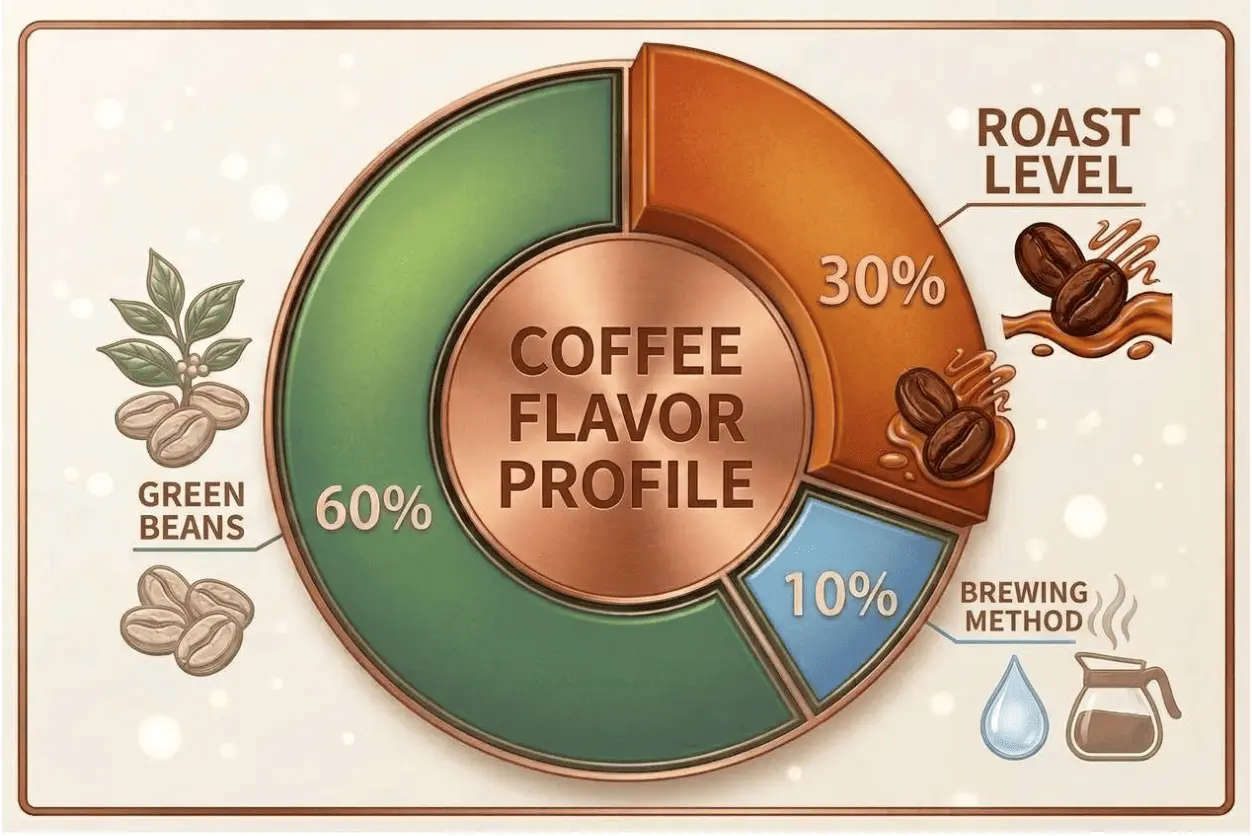
The Flavor Split: Green Beans 60% | Roasting 30% | Brewing 10%
Given the exact same green beans:
- A light roast delivers a bright, acid-forward cup.
- A medium roast shifts toward warm, toasted sweetness with a more lingering finish, showcasing notes like nuts and caramel.
- A dark roast leans heavily into bittersweet roasted characteristics, offering a rich, intense sensory experience often associated with chocolate and spices.
The term “roast level” simply describes how light or dark a batch of coffee has been roasted. This guide is broken into two main sections: (1) How to classify roast levels, and (2) How to execute them during a roast, bridging the gap between understanding the theory and executing it at the drum.
Part 1: How to Classify Roast Levels
Determining a roast level relies on three complementary methods: visual evaluation, sensory tasting, and instrument measurement. Visual checks are immediate but subjective; flavor is our ultimate target; and instruments provide the most objective data.
1-1 Visual Check: Color and Oil Development
During a roast, the bean surface undergoes a sequential color progression:
Green( Green Beans )→White→Yellow→Yellow Brown→Light Brown→Dark Brown
→Oily / Glossy
- Light Roast: Light brown; a clean, matte surface with no oil visible.
- Medium Roast: Medium brown; a smooth surface that remains matte but darker (spotty oil may emerge a few days post-roast).
- Dark Roast: Deep, dark brown; the entire bean surface is coated in a glossy layer of oil (which typically begins bleeding out a few days post-roast).
Additionally, the heavy shedding of chaff (silver skin) serves as a key visual cue during the roast. While visual checks are the fastest, they are heavily influenced by ambient lighting and personal experience, making them a “rough baseline.”
1-2 Sensory Profile: The Flavor Identity of Each Roast Level
| Roast Level | Key Flavors | Acidity / Sweetness / Bitterness Trajectory | Overall Impression |
| Light Roast | Floral, Citrus, Fruity | High acidity, crisp, and bright; preserves the native terroir and origin characteristics. | Highly dynamic and complex |
| Medium Roast | Nuts, Butter, Toasted notes | Pronounced roasted sweetness, heavier body, and a lingering finish; subtle origin nuances remain. | Balanced and moderately complex |
| Dark Roast | Chocolate, Spices | Acidity virtually disappears; intense roasted aromatics with distinct bitterness dominate. | Exceptionally consistent |
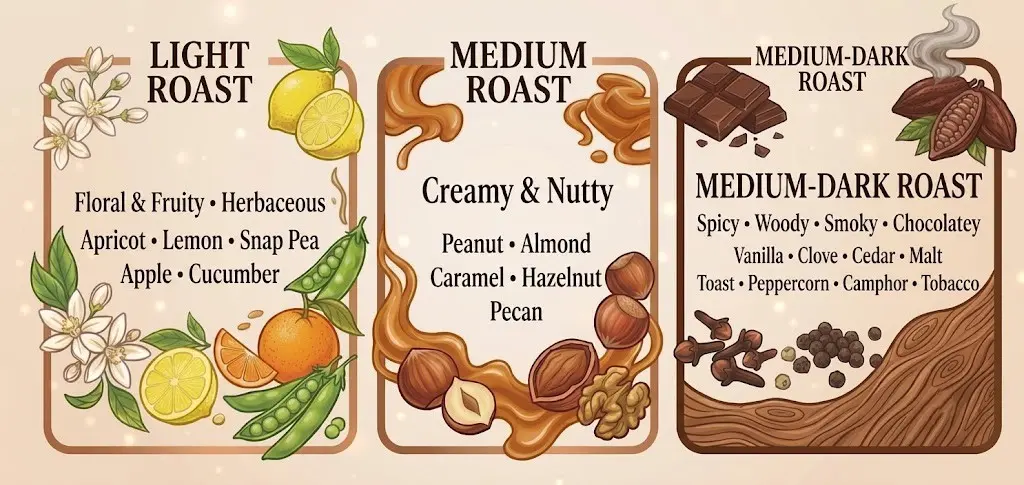
Flavor Profile Comparison Across Three Roast Levels (Light / Medium / Medium-Dark)
While flavor is the ultimate purpose of roasting, it is a lagging indicator—you can only taste the results after the roast is finished, making it impossible to quantify in real time. Therefore, we rely on visual cues and instrumentation to guide our control.
⚠️ Note on Underdevelopment: A light roast does not simply mean “the lighter, the more acidic.” If a roast is taken too light, the bean’s cell walls remain overly tight and structural density prevents proper water penetration during extraction. With fewer chemical reactions triggered, the aromatic compounds remain locked or weak. Sensorially, this results in a hollow, watery, or grass-like cup lacking stimulation—a state defined by the SCA as “underdeveloped.” While some specialty brands pursue ultra-light roasts in the name of “raw origin characteristics,” they occasionally cross into underdevelopment. Roasters should experiment to find their own ideal balance.
1-3 Instrument Measurement: Agtron Colorimetry (The Objective Standard)
Because human eyes and palates are inherently subjective, the industry relies on specialized instruments to communicate roast levels precisely. The undisputed gold standard is the Agtron number.
- What is Agtron? Developed in the 1970s by the Specialty Coffee Association (SCA) in partnership with the Agtron company, this system utilizes infrared light reflection to measure the color of roasted coffee. It essentially evaluates the degree of sucrose caramelization. Since caramelization is directly tied to flavor development, this number goes beyond mere “color”—it dictates chemical progression.
- How to read it? The scale is inverse: higher numbers represent lighter roasts, while lower numbers represent darker roasts, ranging roughly from 0 to over 100.
| Approximate Agtron Value | Roast Level Classification |
| 100+ | Ultra-Light Roast |
| 95 – 75 | Light Roast |
| 65 – 55 | Medium Roast |
| 45 – 25 | Dark Roast |
| < 25 | Carbonized / Burnt |
Structural Benchmarks (Approximate ranges; subject to change based on processing methods and RoR):
| Roasting Milestone | Approximate Agtron Value | Corresponding Roast Level |
| First Crack (Rolling/Peak) | ≈85 | Light Roast |
| End of First Crack | ≈70 | Medium Roast |
| Onset of Second Crack | ≈50 | Dark Roast |
With an Agtron reading, a roaster can declare, “I took this batch to an Agtron 70,” establishing a highly repeatable, professional metric rather than relying on an ambiguous label like “Medium Roast.” For an in-depth exploration of this topic, read Rubasse’s comprehensive guide: Agtron Color Measurement — the MOST comprehensive guide ever.
Part 2: How to Execute a Roast
Once you understand how to classify roast levels, the next step is translating that knowledge into operation. The key lies in mastering the five stages of roasting and using acoustic crack cues to pinpoint the exact drop time.
2-1 The Five Stages of Roasting
| Stage | Operational Milestone | Physical / Chemical Events |
| ① | Preheating | The machine executes an auto preheat sequence to stabilize the drum at the target charge temperature. |
| ② | Drying Phase | Green coffee contains roughly 10–12% moisture. Water evaporates as thermal energy builds internal pressure and drives gas generation. |
| ③ | Maillard Reaction | Bean color transitions from green to white, and then to a yellow-brown hue. Aromas of toasted bread and grain develop, generating an expansive matrix of complex flavor compounds. |
| ④ | Development Time | Deep brown pigments consolidate as the bean mass enters First Crack. The coffee’s definitive flavor profile is locked in here. |
| ⑤ | Discharge & Cooling | The auto cooling mechanism triggers to rapidly drop bean temperature to room level, locking in the flavor and arresting any further chemical reactions. |
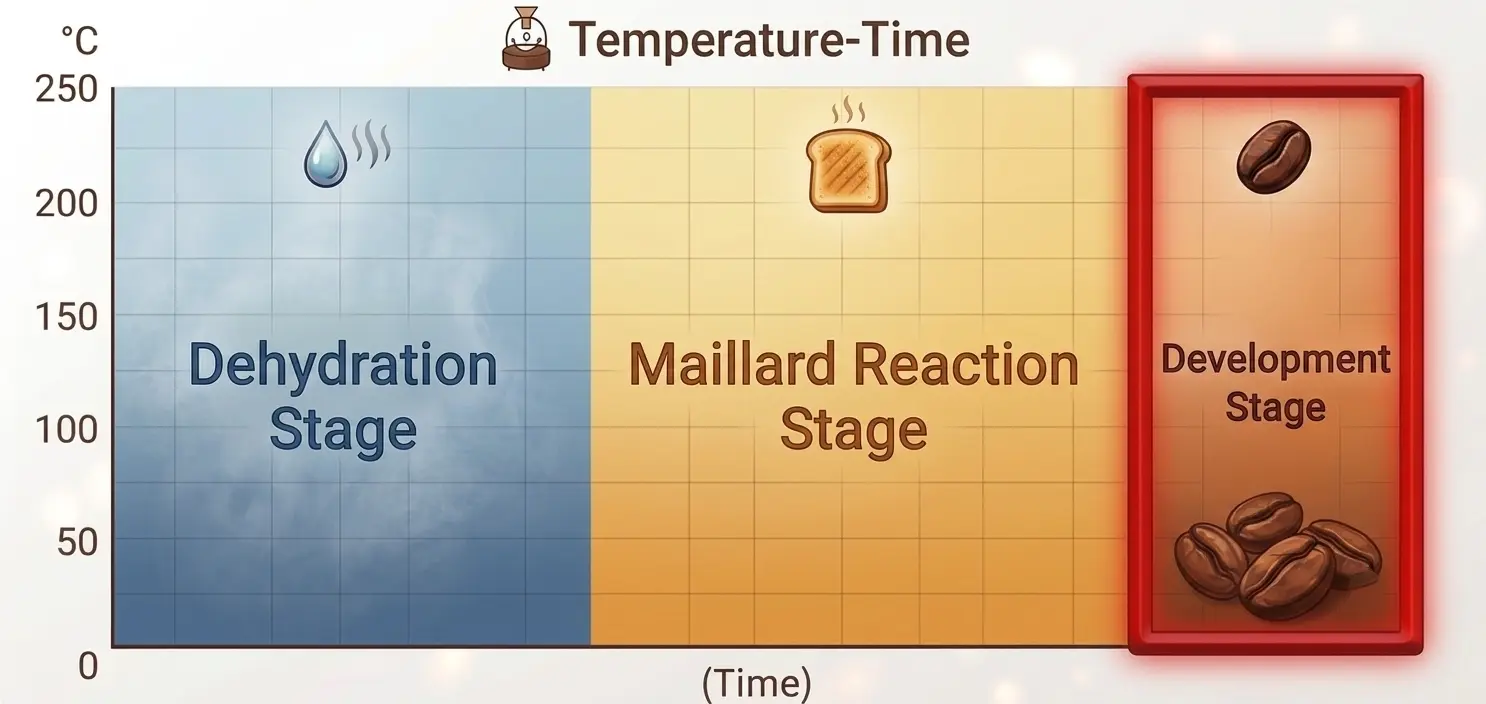
Temperature–Time Distribution Across the Drying Phase, Maillard Reaction, and Development Time
2-2 The Roast Level is Defined by the “Development Time”
Core Concept: The ultimate depth of a roast level is primarily dictated by its development time. The longer the beans remain in the development stage and the higher the final temperature reaches, the darker the roast. Conversely, shorter durations and lower drop temperatures yield lighter roasts.
The thermal journey through the drying phase and Maillard reaction essentially “pushes” the bean toward First Crack. The duration and final temperature path you choose after that point dictate whether your profile finishes as a light, medium, or dark roast. Having the control to manipulate this window is what defines a professional roaster.
2-3 Light Roast: Mid-First Crack (Rolling Crack)
Light roasting aims to highlight delicate floral notes, vibrant fruit profiles, and crisp citrus characteristics, putting the coffee’s inherent terroir on display. (Remember: if a distinct vegetal or grassy note dominates alongside a hollow mouthfeel, the batch is underdeveloped by SCA standards.)
When the bean temperature (BT) hits approximately 200°C, you will hear a sharp, distinct popping sound known as First Crack:
- Chaff separates heavily from the seam.
- Bean color shifts rapidly from yellow to deep brown.
- The beans undergo an endothermic-to-exothermic shift, releasing significant moisture and built-up steam.
- (On machines equipped with exhaust humidity monitoring) The moisture data curve will drop off sharply as First Crack concludes.
For a light roast, the batch is discharged right during the “rolling/peak” phase of First Crack (typically around 210°C), capturing bright fruit acidity and uncompromised origin character.
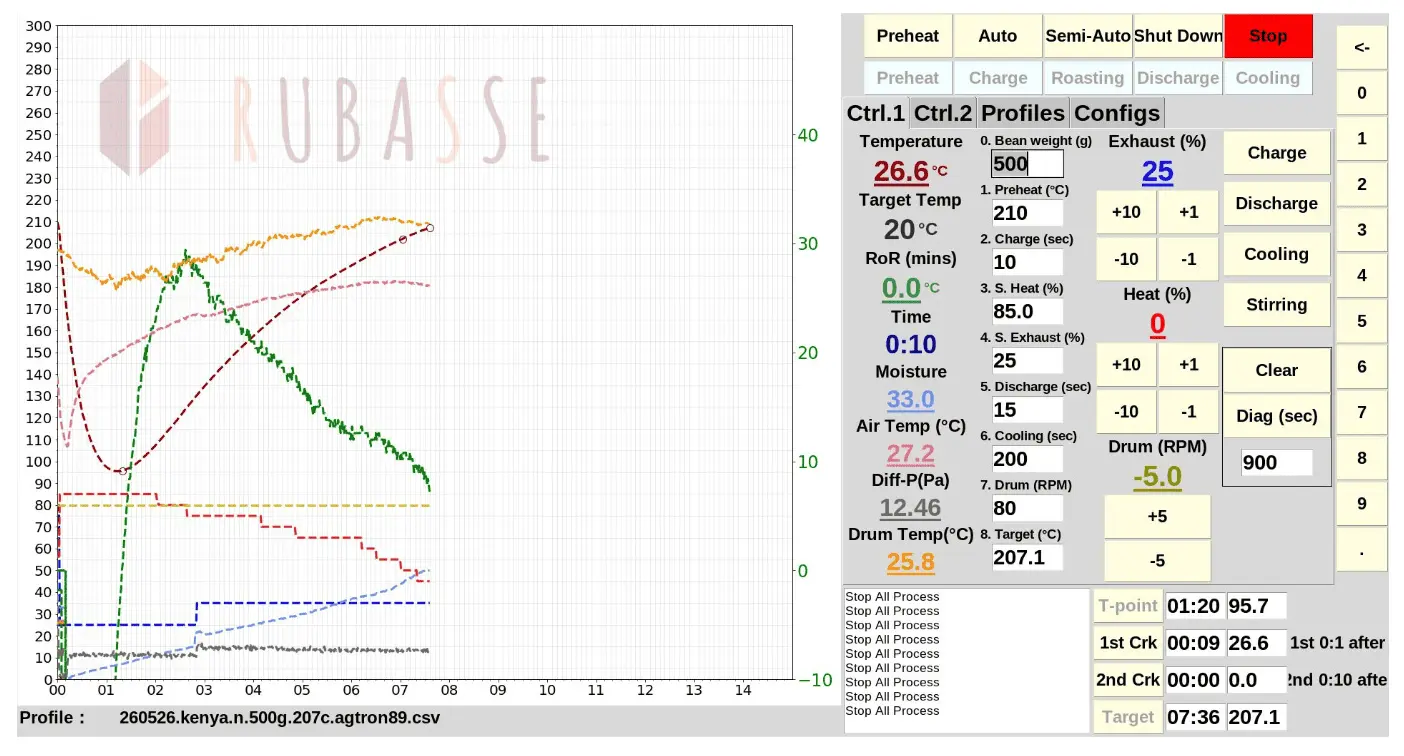
Rubasse Hyper 1.2kg Light Roast Profile: Bean Temperature (BT), Airflow, Drum Speed (RPM), Heat Power, and First Crack / Drop Points
2-4 Medium Roast: End of First Crack
Medium roasts feature a more advanced degree of caramelization compared to light profiles. The focus shifts toward accentuating stone fruit, butter, nuts, and roasted sweetness, bringing a heavier body and enhanced sweet structure. Delicated floral aromas begin to dissipate at this depth.
For a medium roast, the beans are typically dropped just as First Crack completely quietens down (around 216°C), generally settling into a drop window between 218°C and 220°C.
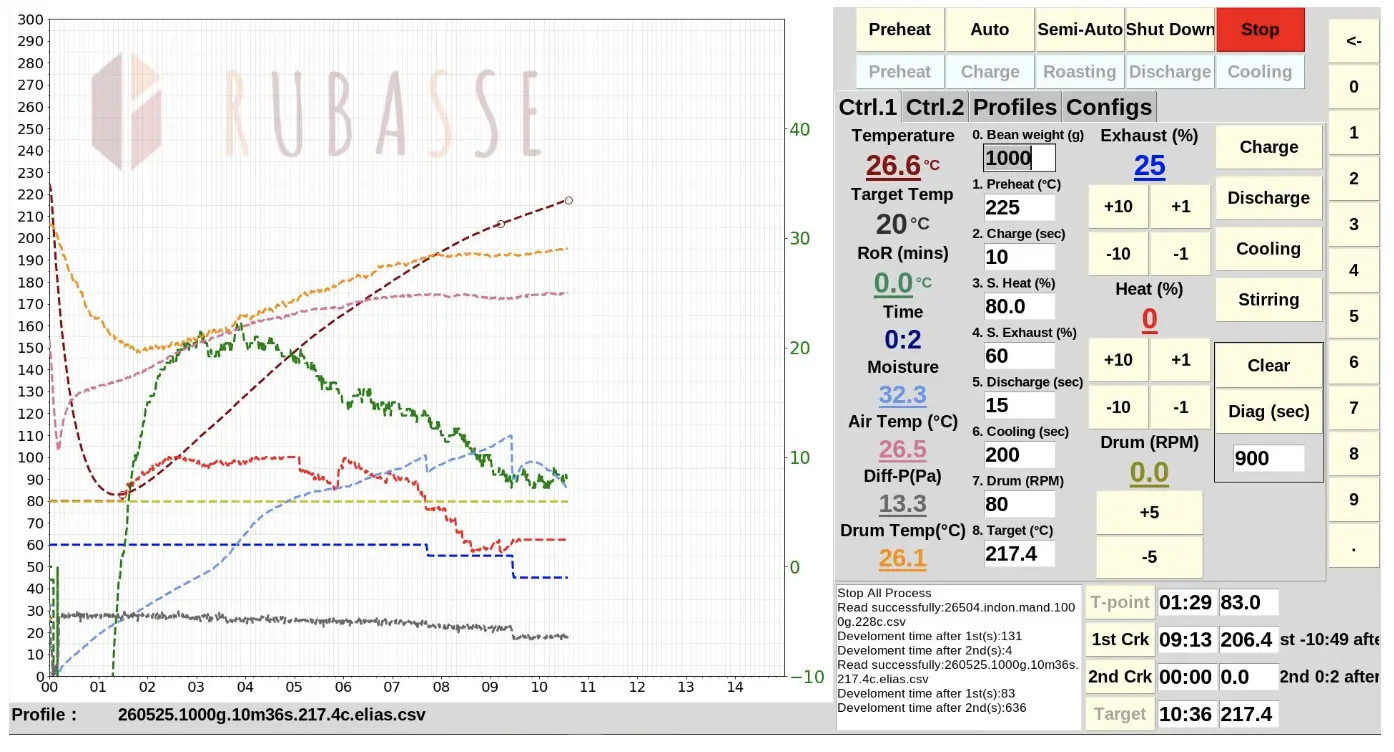
Rubasse Hyper Medium Roast Profile: Bean Temperature (BT), Airflow, Drum Speed (RPM), Heat Power, and First Crack / Drop Points
2-5 Dark Roast: Second Crack as the Benchmark
If heating continues toward 228°C, a second, distinctly different acoustic event occurs: Second Crack. Unlike the loud pops of First Crack, Second Crack is quieter, faster, and more brittle—sounding like a sharp snap or tiny firecrackers.
- Oils rapidly breach the bean surface.
- The bean color deepens into a rich, dark brown.
A dark roast profile is dropped just as the machine approaches or ticks into the very beginning of Second Crack (typically around 228°C to 230°C).
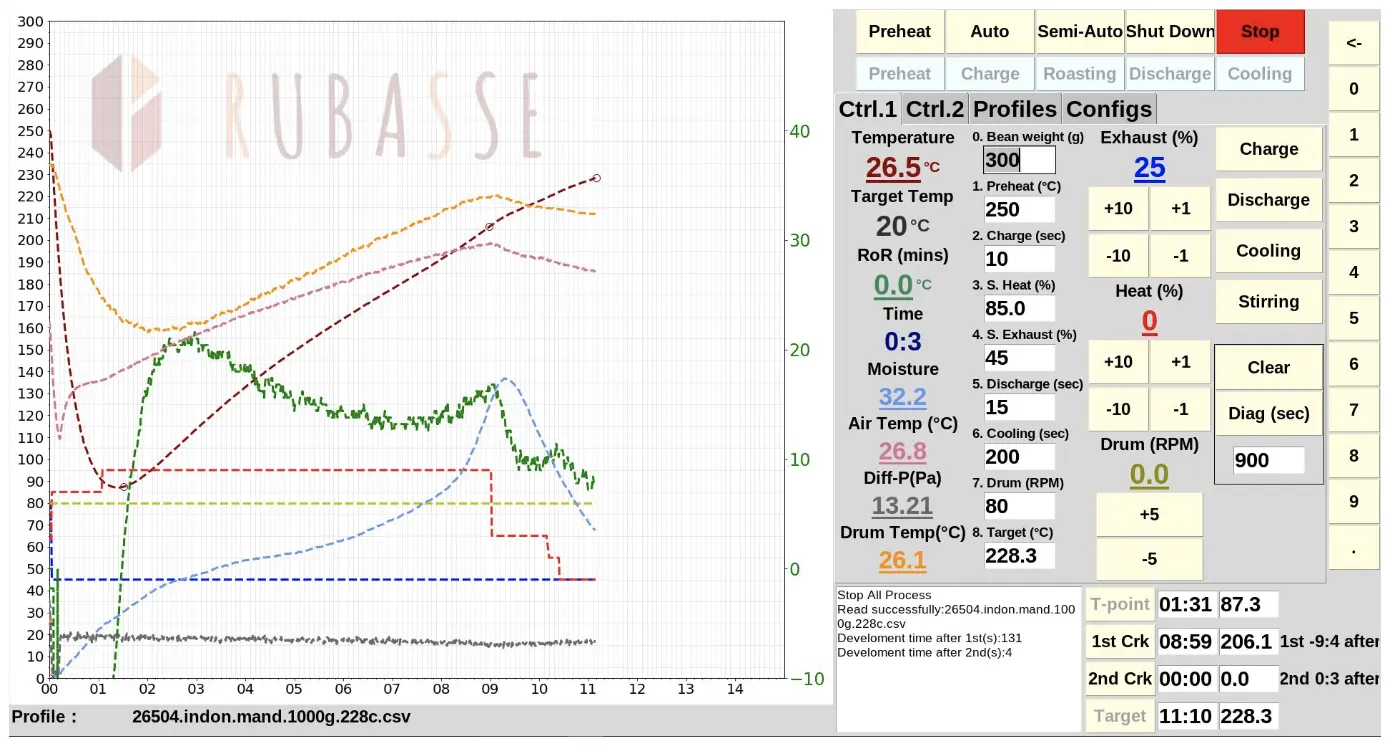
Rubasse Hyper Dark Roast Profile: Bean Temperature (BT), Airflow, Drum Speed (RPM), Heat Power, and First Crack / Drop Points (Dropped at approx. 228°C)
2-6 Quick Reference: Roast Level vs. Acoustic Cues
| Roast Level | Drop Timing | Reference Drop Temperature | Approximate Agtron |
| Light Roast | Mid-First Crack (Rolling) | ≈ 210°C | ≈ 85 |
| Medium Roast | End of First Crack | ≈ 218~220°C | ≈ 70 |
| Dark Roast | Onset of Second Crack | ≈ 228~230°C | ≈ 50 |
Conclusion: Synthesizing the Four Diagnostic Signals
Beginners often fall into the trap of evaluating a roast solely “by eye.” Experienced professionals, however, read four data streams simultaneously to map progress:
- Acoustic Cues (The Ears): Listen to the cracks to accurately time the drop window (Mid-First Crack / End of First Crack / Second Crack).
- Visual Spectrum (The Eyes): Track color evolution for a rapid, real-time baseline assessment.
- Sensory Profile (The Palate & Nose): Evaluate aromas and cup quality—the true destination of the craft.
- Instrumentation (The Metrics): Use Agtron measurements for objective recording, communication, and QA checking.
By linking these four dimensions together and mastering the rule that roast level is defined by the development phase, your roasting workflow will evolve from anxious guesswork to highly reproducible, data-driven mastery.
Appendix: Operational Parameters for the Rubasse Infrared Digital Coffee Roaster (300g Batch)
The following baseline parameters are taken directly from the official Rubasse manual for real-world machine operation. Minor adjustments should be made based on ambient variables and green bean characteristics.
Phase-by-Phase Profile Variations
1. Light Roast (Discharge at rolling First Crack)
- Drying Phase to 150°C: Maintain a Rate of Rise (RoR) of $25 – 15°C/min
- Maillard Reaction (150 – 200°C): Manage an RoR of $18 – 13°C/min.
- Onset of First Crack (200°C): Guide the RoR down to $13 – 5°C/min
- Discharge Point: ≈210°C, during peak rolling crack.
2. Medium Roast (Discharge at the end of First Crack) — Continuing from the Light Roast baseline:
- Late First Crack (213°C): Manage an RoR of $10 – 8°C/min. Scale back heat power to 80%–50% of the baseline setting. (Note: The larger the batch size and the higher the current RoR, the more aggressively you should step down the power percentage).
- End of First Crack (216°C): Target an RoR of $8 – 5°C/min
- Discharge Point:≈ 218 – 220°C
3. Dark Roast (Discharge at onset of Second Crack) — Continuing from the Medium Roast baseline:
- Dark Roast Transition (220°C): Steadily dial back heat power to lock in a stable target RoR of 8 – 5°C/min
- Post-First Crack Interval (225°C): First Crack has completely ceased; hold steady and anticipate Second Crack.
- Discharge Point: ≈228 – 230°C, right as the rapid, brittle snapping of Second Crack initiates.
Batch Size Scaling Matrix (Initial Baseline Reference)
Machine Configuration: Micro 3KG Model
| Green Bean Weight (g) | Charge Temp (°C) | Heat Power | Airflow / Fan Speed | Drum Speed (RPM) |
| 500 | 170 | 35 | 25 | 50 |
| 1000 | 200 | 65 | 40 | 60 |
| 2000 | 230 | 75 | 55 | 65 |
| 3000 | 250 | 80 | 65 | 75 |